August 04, 2009
World of Warcraft and Me: A True Confession
 As part of a course under development at The Open University, I was approached as a known World of Warcraft player and asked to write a short paragraph or two on why I play World of Warcraft. I freely admit to failing to only write a short paragraph or two, but that's probably because I'm passionate about World of Warcraft and my activities in it, especially given the prominence it plays in my life in so many areas. Read on to find out why I play World of Warcraft.
Elsheindra (me)
Hello, my name is Michelle Hoyle. By day, I'm a respectable Open University course author, associate lecturer, and course presentation chair. At night, I assume my secret identity: Elsheindra, night elf guild mistress of The One on a European World of Warcraft (WoW) server. You're probably thinking that massively multiple online role playing games (MMORPGs), like WoW, are just for kids. In fact, according to research (Lenhart et al, 2008; Yee, 2008), only about 20% of WoW players are between the ages of 12 to 19. That means some 80% of players are solid, upstanding citizens of the world. They could be your tutors. They could be your next door neighbours. They could be that person you see walking down the street or buying beef at the butcher's. World of Warcraft, as of May 2009, was holding steady at 11.5 million active subscribers (Blandeburgo, 2009; Chuang, 2009). That's over 60% of the online gaming market. It's the most successful personal computer game ever to be released.
What is it that compels these people to spend around 20 to 24 hours a week (Hagel and Brown, 2009; Yee, 2005) in a virtual world? Is it the killing? Is it the girls? Is it the beautiful scenery? Is it the fantastic fashions? People's motivations vary, so I can't give you a universal motivation, but I can reveal something about why I play. I play for three reasons: because I'm a community builder, because I'm a teacher, and because I love to help people. They're all a bit related. I have spent my life bringing people together and helping them form cohesive, long-lasting communities. It started back in the 1980s with electronic bulletin boards and continues today with World of Warcraft. That's why I run a guild and co-lead an alliance of guilds.
A guild in World of Warcraft is a collection of people who share things in common. The game gives them some tools for sharing, like a shared chat area, calendar, and a bank in which to store money or items for common use. They usually share a philosophy. My guild, for example, is a social guild with a philosophy of doing random acts of kindness. An allied guild is composed of people together for friendship or fun. When my guild members aren't out being kind to the other 4000 people on the server, they have each other to group with on small tasks, called quests, like curing sick deer or ridding an area of nasty rabid bears. A guild is also a pool of people with which to go on longer adventures in groups of five for rewards like armour and gold in mazelike environments where there are obstacles to overcome and difficult, large monsters to kill—so-called dungeons. The alliance of guilds I help lead allows smaller social-minded guilds like mine to be able to participate in even larger, more complex adventures that require 10, 25, or 40 people at a time. It is very rewarding to be in a position to enable people to have fun, but at the same time promote learning of important social interaction and problem solving skills.
Where does the learning come from? The learning is, in fact, everywhere in the game. Those 5-person dungeon groups or the larger 25-person groups require leaders to decide on strategy and direct the other people with varied motivations. Some people go to these dungeons only to get better gear. That's their motivation. Other people go for the feeling of accomplishment in participating in something difficult. When people are there for gear, there can be clashes over who should get it, which requires good interpersonal relationship skills and diplomacy on the part of the group leader. In our guild alliance, we've had leaders good at strategy and telling people what to do but with terrible interpersonal skills. That made their adventures not very fun, so people were reluctant to participate. Likewise, running a successful guild over a long period of time requires all manner of leadership and diplomacy skills. WoW is a safe, low-risk environment in which to learn these things and they can transfer into real-world rewards (Brown and Thomas, 2006).

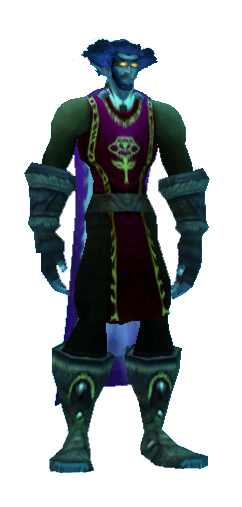
Elsheindra as a healing tree
In order to contribute to a team effectively, people need to learn to play their characters well. Each character has specific abilities. Elsheindra, my character, is a druid healer. She cures people of diseases and poisons and heal their bodies of damage they have taken while fighting. I've specialized in being a healer for over four years. I've become really, really good at healing by dint of lots of practice and much analysis of how things work. I have pride in my abilities and I love being able to help people in the game in a non-violent fashion, because I was not much interested in hacking and slashing at things. Other people are extremely interested in effectively killing things and devote hours outside of the game to reading about their character's role and how to improve on it, often in very tiny increments. I'm very willing to share my knowledge and experience with other people and often other very good players are too.
I've told you a lot about what kinds of things I do in World of Warcraft and my initial motivations. What I haven't told you are the things I've gained: love, acceptance, friendship, and a Ph.D. project, in order of importance. I'm currently researching what elements in games like WoW contribute to motivation and whether or not that can be transferred effectively into distance learning (Hoyle, 2009a; 2009b). Both feature activities that are a lot of work and, let's face it, aren't fun. In World of Warcraft, though, people persist with these difficult, not-fun tasks. I know I've persisted in some things because of the friends I've made. Those friendships have even transcended the virtual world, with people helping me move from apartment to apartment multiple times, even though they live in a different city.
Basil, my partner
The alliance of guilds I co-run just had a real-life adventure at Bletchley Park and a BBQ at my house afterwards, one of several such successful large-scale events over the years. It's also not uncommon for some of my guild mates to just come and visit from other parts of the UK or from other countries. One of my guild mates even came along from Denmark to Canada for the summer. Are we just strange misfits? That's a common perception of gamers. I don't fit in lots of places but in WoW there's a place for me, as there is for them, and it's not just because "on the Internet nobody knows you're a dog". Finally, "Basil", my real-life partner, is someone I met in WoW because he was helping me co-lead the alliance of guilds. We've been together for over two and a half years. We still play WoW together on a regular basis, although not 20 some hours a week. There's nothing like a romantic date night with your beloved and 23 other friends.
WoW is like a fairy tale: magic, dragons, true love, fashion, elves, and orcs; but it's also what I've made of it: a place to be myself and to do the things I love to do.
References
Blandeburgo, B. (2009) ‘Activision "WoWs," But Where's Wireless?’, The Game Trade Journal, blog entry posted March 4, 2009. Available from: http://www.gametradejournal.com/2009/03/activision-wows-but-wheres-wireless.html (Accessed August 4, 2009).
Brown, J.S. & Thomas, D. (2006) ‘You Play World of Warcraft? You're Hired!’ Wired, 14.04 [Online] Available from: http://www.wired.com/wired/archive/14.04/learn.html (Accessed August 4, 2009).
Chuang, T. (2009) ‘WoW Stuck at 11.5 Million Subscribers; Blizz Focused on StarCraft, Diablo’, OCRegister Blizzard Blog, blog entry posted May 7, 2009. Available from: http://gaming.freedomblogging.com/2009/05/07/wow-stuck-at-115-million-subscribers-blizz-focused-on-starcraft-diablo/2201/ (Accessed August 4, 2009).
Hagel, J. & Brown, J.S. (2009) ‘How World of Warcraft Promotes Innovation’ Business Week Online, January 14 [Online] Available from: http://www.businessweek.com/innovate/content/jan2009/id20090114_362962.htm (Accessed August 4, 2009).
Hoyle, M.A. (2009a) ‘Levelling Lifelong Learning: Annual Progress Review’, E1n1verse, blog entry posted June 7, 2009. Available from: http://einiverse.eingang.org/archives/2009/06/levelling_lifel.php (Accessed August 4, 2009).
Hoyle, M. (2009b) WoW! Roberts & Susans Game Learning, [online] Slide presentation. Available from: http://www.slideshare.net/Eingang/wow-roberts-and-susans-game-learning-a-look-at-world-of-warcraft-higher-education-learning-and-motivation (Accessed August 4, 2009).
Lenhart, A. et al. (2008) Teens, Video Games, and Civics, Pew Internet & American Life Project. Available from: http://www.pewinternet.org/Reports/2008/Teens-Video-Games-and-Civics.aspx (Accessed August 4, 2009).
Yee, N. (2005) ‘MMORPG Hours vs. TV Hours’, The Daedalus Project, blog entry posted January 11, 2005. Available from: http://www.nickyee.com/daedalus/archives/000891.php (Accessed August 4, 2009).
Yee, N. (2008) The Daedulus Project, [online]. Available from: http://www.nickyee.com/daedalus/docs/shared-data.php (Accessed August 4, 2009).
October 27, 2008
What Do I Know? A Reflection on Influences
For the first time in years, I'm taking a postgraduate course myself: H812: Postgraduate Certificate in Academic Practice, which I'm doing both for personal development and to provide theoretical groundwork in educational pedagogy for my Ph.D. work in educational technology.
A recent activity asked us to reflect on influences on our teaching practices, considering: practices arising from personal experiences as a student; practices from our departments; and practices we can attribute to other sources. In addition, we were asked to consider aspects of our workplace that favoured or hindered good practice. I starting making notes on the 14th of October. I did not post them to my group because I felt this was a really important activity. If you don't know where you've come from, it can be difficult to move ahead in a purposeful fashion. I wanted this activity to serve as a good baseline, so I invested a substantial amount of effort into thinking about it and writing it up in a coherent, cohesive fashion.
What Do I Know?
A Reflection on Influences
Activity 3 (The Open University n.d.) mentions research by Peter Knight revealing that our experiences as students can significantly influence our teaching practices. This is very reminiscent of the commonly held belief that, try as people might, they often end up behaving like their parents did when they have families of their own. Considering both ideas, they are obviously generalizations that do not always hold true. Anecdotes abound of cases where a student or a child exposed to some very extreme practices rebelled by going to the other end of the extreme. Exposure to negative or adverse practices can make us better people and better teachers, as can exposure to good practices.
| Practice | Effect |
|---|---|
|
Reading from the book or slides. |
Negative effect. It does not add value.
|
|
Learning by doing. |
Positive effect. Doing something builds stronger associations than just reading or watching something.
|
|
Lack of enthusiasm. |
Negative effect. If you are bored and uninspired, the students will be too.
|
Table 1: Practices learned as a student and their effects.
While enumerating my positive or negative teaching practice influences, I realized that adversity has made me a stronger person and I did l learn some important things about teaching while a student (see Table 1). For example, reading from slides or teaching directly to the book does not add any value to the learning experience because students can do that for themselves; and a lack of enthusiasm from the instructor is clearly communicated to students, resulting in a dismissive, disinterested attitude to the material. The latter might not technically be classified as a “teaching practice”, but its effect is just as important, if not more so, than teaching practice. Enthusiasm and passion can overcome defects in materials and teaching experience, just as learning by doing can.
| Practice | Effect |
|---|---|
|
Reflection.
|
Positive effect. If you do not know what works or does not work, improvement is difficult.
|
|
Monitoring. |
Positive effect. Feedback on your practices helps you improve.
|
|
Mentoring. |
Positive effect. Advice on practices and culture help ensure your practice is in line with what is expected.
|
Table 2: Practices learned as from the Faculty of Technology at the Open University
These are not the strongest influences on my teaching practices, though. Practices at the Open University, which I joined in 2000, have very significantly affected the way I view and practice teaching, even though I had considerable experience and more responsibility at bricks-and-mortar institutions previously. The Faculty of Technology—now the Faculty of Maths, Computing and Technology— first introduced me to the closely related trio of: monitoring, reflection, and mentoring (see Table 2). Mentoring is where an associate lecturer is given a more experienced colleague to give advice on practices and culture at the Open University. Monitoring is where another colleague—staff tutor, experienced associate lecturer, or course team member—double marks some of your assignments and provides feedback on how closely you are adhering to the marking guidelines and on the quality of your correspondence tuition. Reflection helps tie these two other practices together. If you think about what you have done and how it has worked or has not worked and you take into account advice and feedback you are being given, you can actively plan ways to improve your practice.
| Aspect | Effect |
|---|---|
|
Professional development events. |
Positive effect. Presentations, courses, and networking opportunities to be exposed to new courses, new ideas, and the practices of others.
|
|
Research into good practice. |
Positive effect. The Institute for Technology actively researches factors into effective e-learning and distance education incorporating technology. This research eventually manifests as practices at the Open University.
|
|
Grants/fee waivers for professional development. |
Positive effect. Associate lecturers and staff can take advantage of postgraduate courses being offered into educational practice and theory, such as H812, at no cost to themselves.
|
Table 3: Aspects of the Open University that Promote Good Practice
Possibly surprisingly, the biggest personal benefit I derived from mentoring and monitoring was not from receiving it myself but in providing it to others. One of the aspects of the Open University that hinders good practice is the geographical distance between associate lecturers in the same faculty or even on the same course. While the faculty does try to encourage good practice by holding staff development conference (see Table 3), these are few and far between. Prior to the recent explosion of social networking sites like Twitter, Facebook, and Plurk1, associate lecturers tended to be fairly isolated. The Open University tried to overcome that by having various FirstClass discussion forums, but the opportunity to directly observe the practices of others was non-existent for most associate lecturers due to the digital divide2. Seeing and reflecting on the practice of others as a monitor and as a mentor has been extremely rewarding. I highly recommend volunteering to mentor or monitor if you have the opportunity. You can learn as much by teaching others as others learn from your teaching in some cases.
Being in an institution that actively research into good practice is also extremely beneficial. The Open University’s Institute for Educational Technology (IET) is comprised of many individuals who are passionately interested in exploring what makes for good teaching in an online world and how our pedagogical practices can be leveraged through the use of educational technology. That research and expertise eventually makes its way into postgraduate courses that the Open University offers, such as their latest course H810: Accessible Online Learning3. Many of their courses can be taken free of charge by Open University staff to help further their personal development either via a fee waiver or through a staff grant4. These are excellent opportunities to explore recent advances or to acquire a firmer pedagogical grounding for existing practice.
| Aspect | Effect |
|---|---|
|
Developing materials in advance of use. |
Negative effect. If you do not know what works or does not work, improvement is difficult.
|
|
Geographical separation of associate lecturers. |
Negative effect. Feedback on your practice helps you improve.
|
|
Distance of course teams from learners. |
Negative effect. Advice on practices and culture help ensure your practice is in line with what is expected.
|
|
Human resources hiring and retention practices. |
Negative effect. Phasing out experienced people at age 65; hiring inexperienced people over experienced people because of contract holdings (or lack thereof); awarding contracts at the last minute so income and job security is not predictable; little incentive to do better as not likely to be fired.
|
|
Cultural ethos about the role of the associate lecturer. |
Negative effect. People who feel unappreciated or taken advantage of are less motivated to improve or to do good work.
|
Table 4: Aspects of the Open University that Hinder Good Practice
Although the Open University has been very good about encouraging professional development of associate lecturers, in my position as a course chair and content developer I have been exposed to the negative sides of Open University practices (see Table 4). For example, even on courses delivered completely online, like H812 or TT281, course authors are strongly encouraged to have all the material developed or updated months in advance of the course’s start date. Furthermore, once the course has begun, there is very little opportunity to change any material. That means it cannot be adapted to the needs of the current cohort easily if need be. It is what it is. The production schedule does help ensure quality content but it sacrifices flexibility and situation adaptation as the course unfolds.
Closely related to the lack of flexibility is a factor that Will Swann, Director of Students at the Open University, commented on a year or so ago5: course teams tend to be divorced from the learners. Typically a course team develops the content but the learning process is overseen by associate lecturers who, in the current corporate ethos, are not seen as teaching but as supporting learners. Who is teaching the learners then? Nobody! The students, in this model, have no interaction with the course team who developed the content and therefore no contact with any “teachers.” The reality is actually quite different, with many associate lecturers engaging in traditional “teaching” activities. However, perception of the associate lecturer role, while a negative factor, is tangential to the other important issues listed in Table 4.
| Factor | Effect |
|---|---|
|
Forum facilitation |
Positive effect. Personal experience from working with online bulletin boards and building virtual communities since the early 1980s has been crucial in forming my e-moderating practices.
|
|
Organization |
Positive effect. Information processing disability requires an ability to organize my thoughts and materials. It has also encouraged me to be very clear about elucidating the steps involved in problem solving.
|
|
Presentations |
Positive effect. "Less is more” philosophy of slide development, so that slides are not text-heavy, forcing the audience to pay more attention to the slide than me. Slides provide visual support of the points I am verbally making. To keep myself on track, I produce a mind map of my talk. This enables me to focus not just on delivering knowledge (“sage on the stage”) but on actively communicating the big picture and encouraging participation and immersion in the topic.
|
|
Input from learners |
Positive effect. Understanding how students feel when receiving four lines of commentary for their essays or seeing firsthand the problems they have grappling with concepts provides excellent feedback about how to better prepare and present materials and assessment commentary. Some of this information is gained by interacting with students of other courses in social networking sites, through observation in forums of what questions students pose, or by directly asking students.
|
|
Participatory teaching |
Positive effect. Ties in well to learning by doing and students can become highly motivated and feel a sense of “ownership” if they have control over what and how a topic is presented by doing the work themselves. I was able to do this several times as a undergraduate and I’ve been actively following Howard Rheingold’s latest effort in participatory teaching with his Virtual Communities & Social Media course at Stanford using the Social Media CoLab software he co-developed6.
|
|
Social collaboration/social knowing |
Positive effect. E-Learn 2.0 is all about social collaboration and social knowing. The paper “Minds on Fire: Open Education, the Long Tail, and Learning 2.0” (Brown, 2008) has been influential in coalescing my ideas for building knowledge socially and the advantages of that.
|
Table 5: Other Influences on My Practices
I have not relied solely on the Open University and my own educational experiences to shape my teaching practices. I am also influenced by a community of educational technologists around the world and my own experiences with information processing and learners. Table 5 outlines some of the other factors I have drawn upon. The first three —forum facilitation, organization, and presentations—have been crucial in molding my approaches to higher online education and content delivery and they are based solely upon active reflection of my own experiences and attempts. The last three reflect my interest in community building and the power of social knowledge. These are the topics underpinning the phenomenal success of a Web 2.0 world with Facebook, Flickr, and Wikipedia. Like John Seely Brown, I believe there is great potential there for learning and teaching outside the very staid “sage on the stage” model so much in favour still in higher education, which is why I have chosen to work in this area for my D.Phil. research. This is also a topic of interest at the Open University. Martin Weller and Simon Buckingham Shum are involved with the SocialLearn project7, which is looking at developing tools to facilitate social learning online.
So where do we go from here? Should we be belittling academics at universities for their poor teaching practices? With the exception of the Open University, which is not a university using a traditional teaching style, it is difficult to be critical of lecturers in higher education, because the vast majority of them, unless they are in a department involved in the teaching of educational principles, have received no training in how to teach. Their practices are the result of what they have been exposed to. The other issue is that universities are also driven by different demands at different times. At the moment, many universities seem driven to improve their research so as to get more research money; as a result, teaching tends to get short-shrifted. There also previously was very little incentive to be good at teaching, at least from the institutions themselves. Even students were fairly resigned to the endless, boring lectures. With the advent of HEFCE monitoring of the “student experience” plus the change to students paying fees, I am hopeful we might see a resurgence of institutionally-supported professional development and accreditation for lecturers in higher education. I recognize that I am lucky to be situated where I am in the Open University, with a wealth of resources and opportunities for improvement and practice available to me.
Footnotes:
1. Twitter and Plurk are so-called “microblogging” sites where you have friends and fans who follow your postings. Postings are extremely short, limited to 140 characters. Facebook is perhaps more well-known, sometimes negatively as people post compromising pictures of themselves that result in lost jobs or denial to universities. Used in a positive way, though, these sites can reduce isolation caused by working in a digital world. Twitter: http://twitter.com/. Plurk: /http://www.plurk.com/. FaceBook: http://www.facebook.com/.
2. The Wikipedia quick and dirty definition of “digital divide” is “the gap between those people with effective access to digital and information technology and those without.” (Wikipedia, 2008). The term originates, as far as I can tell, in a paper reporting the findings from a national survey done in 1996 by James Katz (Katz & Aspden, 1997) contrasting those who have computer and Internet access and those who do not.
Although the Faculty of Technology did not have this problem, I am aware that other faculties at the Open University have been slow to embrace initiatives like the eTMA system, TutorHome, etc., due to a lack of comfort with computers or lack of access in their own personal lives. The OU branch of the UCU (University and College Union) was just recently (October, 2008) conducting a survey of ALs about workload and computer-related conditions and expenses, as I think hard data that is accessible is in short supply.
3. H810: Accessible Online Learning: Supporting Disabled Students is currently in its pilot presentation. More information is available from http://www3.open.ac.uk/courses/bin/p12.dll?C01H810 (Accessed October 26, 2008).
4. Information on course fee waivers is available from http://www.open.ac.uk/tutors/development/staff-fee-waivers.php. Information on the Associate Lecturer Development Fund can be found at http://www.open.ac.uk/tutors/development/associate-lecturer-development-fund.php (Accessed October 26, 2008).
5. Unfortunately, I don’t have a reference to this on hand. I believe I read about it summarized in Sesame or another OU publication aimed at staff.
6. The Drupal-based Social Media Classroom is now available for download and use by other educators. It is also being used to build a community of practice, led by Howard Rheingold, around the use of social media in education. http://www.socialmediaclassroom.com/ (Accessed October 26, 2008) for more information.
7. The SocialLearn platform is a collection of tools with the intention of making the education system adapt to the learner by leveraging the values and principles found in new social web technologies. http://www.open.ac.uk/blogs/sociallearn/index.php (Accessed October 26, 2008).
References:
Brown, John Seely, and Richard P. Adler. 2008. “Minds on Fire: Open Education, the Long Tail, and Learning 2.0.” Educause Review 43(1) :16-32. Available from http://connect.educause.edu/Library/EDUCAUSE+Review/MindsonFireOpenEducationt/45823 (Accessed August 22, 2008).
Katz, James, and Philip Aspden. 1997. “Motivations for and Barriers to Internet Usage: Results of a National Public Opinion Survey.” Internet Research 7(3) :170-188.
The Open University (n.d.) H812-08J: Activity 3: What Do You Know? The Open University. Web page. http://learn.open.ac.uk/mod/resourcepage/view.php?id=87392 (Accessed October 26, 2008).
Wikipedia (2008.) Digital Divide. Web page. http://en.wikipedia.org/wiki/Digital_divide (Accessed October 26, 2008).
What Do I Know? A Reflection on Influences
For the first time in years, I'm taking a postgraduate course myself: H812: Postgraduate Certificate in Academic Practice, which I'm doing both for personal development and to provide theoretical groundwork in educational pedagogy for my Ph.D. work in educational technology.
A recent activity asked us to reflect on influences on our teaching practices, considering: practices arising from personal experiences as a student; practices from our departments; and practices we can attribute to other sources. In addition, we were asked to consider aspects of our workplace that favoured or hindered good practice. I starting making notes on the 14th of October. I did not post them to my group because I felt this was a really important activity. If you don't know where you've come from, it can be difficult to move ahead in a purposeful fashion. I wanted this activity to serve as a good baseline, so I invested a substantial amount of effort into thinking about it and writing it up in a coherent, cohesive fashion.
What Do I Know?
A Reflection on Influences
Activity 3 (The Open University n.d.) mentions research by Peter Knight revealing that our experiences as students can significantly influence our teaching practices. This is very reminiscent of the commonly held belief that, try as people might, they often end up behaving like their parents did when they have families of their own. Considering both ideas, they are obviously generalizations that do not always hold true. Anecdotes abound of cases where a student or a child exposed to some very extreme practices rebelled by going to the other end of the extreme. Exposure to negative or adverse practices can make us better people and better teachers, as can exposure to good practices.
| Practice | Effect |
|---|---|
|
Reading from the book or slides. |
Negative effect. It does not add value.
|
|
Learning by doing. |
Positive effect. Doing something builds stronger associations than just reading or watching something.
|
|
Lack of enthusiasm. |
Negative effect. If you are bored and uninspired, the students will be too.
|
Table 1: Practices learned as a student and their effects.
While enumerating my positive or negative teaching practice influences, I realized that adversity has made me a stronger person and I did l learn some important things about teaching while a student (see Table 1). For example, reading from slides or teaching directly to the book does not add any value to the learning experience because students can do that for themselves; and a lack of enthusiasm from the instructor is clearly communicated to students, resulting in a dismissive, disinterested attitude to the material. The latter might not technically be classified as a “teaching practice”, but its effect is just as important, if not more so, than teaching practice. Enthusiasm and passion can overcome defects in materials and teaching experience, just as learning by doing can.
| Practice | Effect |
|---|---|
|
Reflection.
|
Positive effect. If you do not know what works or does not work, improvement is difficult.
|
|
Monitoring. |
Positive effect. Feedback on your practices helps you improve.
|
|
Mentoring. |
Positive effect. Advice on practices and culture help ensure your practice is in line with what is expected.
|
Table 2: Practices learned as from the Faculty of Technology at the Open University
These are not the strongest influences on my teaching practices, though. Practices at the Open University, which I joined in 2000, have very significantly affected the way I view and practice teaching, even though I had considerable experience and more responsibility at bricks-and-mortar institutions previously. The Faculty of Technology—now the Faculty of Maths, Computing and Technology— first introduced me to the closely related trio of: monitoring, reflection, and mentoring (see Table 2). Mentoring is where an associate lecturer is given a more experienced colleague to give advice on practices and culture at the Open University. Monitoring is where another colleague—staff tutor, experienced associate lecturer, or course team member—double marks some of your assignments and provides feedback on how closely you are adhering to the marking guidelines and on the quality of your correspondence tuition. Reflection helps tie these two other practices together. If you think about what you have done and how it has worked or has not worked and you take into account advice and feedback you are being given, you can actively plan ways to improve your practice.
| Aspect | Effect |
|---|---|
|
Professional development events. |
Positive effect. Presentations, courses, and networking opportunities to be exposed to new courses, new ideas, and the practices of others.
|
|
Research into good practice. |
Positive effect. The Institute for Technology actively researches factors into effective e-learning and distance education incorporating technology. This research eventually manifests as practices at the Open University.
|
|
Grants/fee waivers for professional development. |
Positive effect. Associate lecturers and staff can take advantage of postgraduate courses being offered into educational practice and theory, such as H812, at no cost to themselves.
|
Table 3: Aspects of the Open University that Promote Good Practice
Possibly surprisingly, the biggest personal benefit I derived from mentoring and monitoring was not from receiving it myself but in providing it to others. One of the aspects of the Open University that hinders good practice is the geographical distance between associate lecturers in the same faculty or even on the same course. While the faculty does try to encourage good practice by holding staff development conference (see Table 3), these are few and far between. Prior to the recent explosion of social networking sites like Twitter, Facebook, and Plurk1, associate lecturers tended to be fairly isolated. The Open University tried to overcome that by having various FirstClass discussion forums, but the opportunity to directly observe the practices of others was non-existent for most associate lecturers due to the digital divide2. Seeing and reflecting on the practice of others as a monitor and as a mentor has been extremely rewarding. I highly recommend volunteering to mentor or monitor if you have the opportunity. You can learn as much by teaching others as others learn from your teaching in some cases.
Being in an institution that actively research into good practice is also extremely beneficial. The Open University’s Institute for Educational Technology (IET) is comprised of many individuals who are passionately interested in exploring what makes for good teaching in an online world and how our pedagogical practices can be leveraged through the use of educational technology. That research and expertise eventually makes its way into postgraduate courses that the Open University offers, such as their latest course H810: Accessible Online Learning3. Many of their courses can be taken free of charge by Open University staff to help further their personal development either via a fee waiver or through a staff grant4. These are excellent opportunities to explore recent advances or to acquire a firmer pedagogical grounding for existing practice.
| Aspect | Effect |
|---|---|
|
Developing materials in advance of use. |
Negative effect. If you do not know what works or does not work, improvement is difficult.
|
|
Geographical separation of associate lecturers. |
Negative effect. Feedback on your practice helps you improve.
|
|
Distance of course teams from learners. |
Negative effect. Advice on practices and culture help ensure your practice is in line with what is expected.
|
|
Human resources hiring and retention practices. |
Negative effect. Phasing out experienced people at age 65; hiring inexperienced people over experienced people because of contract holdings (or lack thereof); awarding contracts at the last minute so income and job security is not predictable; little incentive to do better as not likely to be fired.
|
|
Cultural ethos about the role of the associate lecturer. |
Negative effect. People who feel unappreciated or taken advantage of are less motivated to improve or to do good work.
|
Table 4: Aspects of the Open University that Hinder Good Practice
Although the Open University has been very good about encouraging professional development of associate lecturers, in my position as a course chair and content developer I have been exposed to the negative sides of Open University practices (see Table 4). For example, even on courses delivered completely online, like H812 or TT281, course authors are strongly encouraged to have all the material developed or updated months in advance of the course’s start date. Furthermore, once the course has begun, there is very little opportunity to change any material. That means it cannot be adapted to the needs of the current cohort easily if need be. It is what it is. The production schedule does help ensure quality content but it sacrifices flexibility and situation adaptation as the course unfolds.
Closely related to the lack of flexibility is a factor that Will Swann, Director of Students at the Open University, commented on a year or so ago5: course teams tend to be divorced from the learners. Typically a course team develops the content but the learning process is overseen by associate lecturers who, in the current corporate ethos, are not seen as teaching but as supporting learners. Who is teaching the learners then? Nobody! The students, in this model, have no interaction with the course team who developed the content and therefore no contact with any “teachers.” The reality is actually quite different, with many associate lecturers engaging in traditional “teaching” activities. However, perception of the associate lecturer role, while a negative factor, is tangential to the other important issues listed in Table 4.
| Factor | Effect |
|---|---|
|
Forum facilitation |
Positive effect. Personal experience from working with online bulletin boards and building virtual communities since the early 1980s has been crucial in forming my e-moderating practices.
|
|
Organization |
Positive effect. Information processing disability requires an ability to organize my thoughts and materials. It has also encouraged me to be very clear about elucidating the steps involved in problem solving.
|
|
Presentations |
Positive effect. "Less is more” philosophy of slide development, so that slides are not text-heavy, forcing the audience to pay more attention to the slide than me. Slides provide visual support of the points I am verbally making. To keep myself on track, I produce a mind map of my talk. This enables me to focus not just on delivering knowledge (“sage on the stage”) but on actively communicating the big picture and encouraging participation and immersion in the topic.
|
|
Input from learners |
Positive effect. Understanding how students feel when receiving four lines of commentary for their essays or seeing firsthand the problems they have grappling with concepts provides excellent feedback about how to better prepare and present materials and assessment commentary. Some of this information is gained by interacting with students of other courses in social networking sites, through observation in forums of what questions students pose, or by directly asking students.
|
|
Participatory teaching |
Positive effect. Ties in well to learning by doing and students can become highly motivated and feel a sense of “ownership” if they have control over what and how a topic is presented by doing the work themselves. I was able to do this several times as a undergraduate and I’ve been actively following Howard Rheingold’s latest effort in participatory teaching with his Virtual Communities & Social Media course at Stanford using the Social Media CoLab software he co-developed6.
|
|
Social collaboration/social knowing |
Positive effect. E-Learn 2.0 is all about social collaboration and social knowing. The paper “Minds on Fire: Open Education, the Long Tail, and Learning 2.0” (Brown, 2008) has been influential in coalescing my ideas for building knowledge socially and the advantages of that.
|
Table 5: Other Influences on My Practices
I have not relied solely on the Open University and my own educational experiences to shape my teaching practices. I am also influenced by a community of educational technologists around the world and my own experiences with information processing and learners. Table 5 outlines some of the other factors I have drawn upon. The first three —forum facilitation, organization, and presentations—have been crucial in molding my approaches to higher online education and content delivery and they are based solely upon active reflection of my own experiences and attempts. The last three reflect my interest in community building and the power of social knowledge. These are the topics underpinning the phenomenal success of a Web 2.0 world with Facebook, Flickr, and Wikipedia. Like John Seely Brown, I believe there is great potential there for learning and teaching outside the very staid “sage on the stage” model so much in favour still in higher education, which is why I have chosen to work in this area for my D.Phil. research. This is also a topic of interest at the Open University. Martin Weller and Simon Buckingham Shum are involved with the SocialLearn project7, which is looking at developing tools to facilitate social learning online.
So where do we go from here? Should we be belittling academics at universities for their poor teaching practices? With the exception of the Open University, which is not a university using a traditional teaching style, it is difficult to be critical of lecturers in higher education, because the vast majority of them, unless they are in a department involved in the teaching of educational principles, have received no training in how to teach. Their practices are the result of what they have been exposed to. The other issue is that universities are also driven by different demands at different times. At the moment, many universities seem driven to improve their research so as to get more research money; as a result, teaching tends to get short-shrifted. There also previously was very little incentive to be good at teaching, at least from the institutions themselves. Even students were fairly resigned to the endless, boring lectures. With the advent of HEFCE monitoring of the “student experience” plus the change to students paying fees, I am hopeful we might see a resurgence of institutionally-supported professional development and accreditation for lecturers in higher education. I recognize that I am lucky to be situated where I am in the Open University, with a wealth of resources and opportunities for improvement and practice available to me.
Footnotes:
1. Twitter and Plurk are so-called “microblogging” sites where you have friends and fans who follow your postings. Postings are extremely short, limited to 140 characters. Facebook is perhaps more well-known, sometimes negatively as people post compromising pictures of themselves that result in lost jobs or denial to universities. Used in a positive way, though, these sites can reduce isolation caused by working in a digital world. Twitter: http://twitter.com/. Plurk: /http://www.plurk.com/. FaceBook: http://www.facebook.com/.
2. The Wikipedia quick and dirty definition of “digital divide” is “the gap between those people with effective access to digital and information technology and those without.” (Wikipedia, 2008). The term originates, as far as I can tell, in a paper reporting the findings from a national survey done in 1996 by James Katz (Katz & Aspden, 1997) contrasting those who have computer and Internet access and those who do not.
Although the Faculty of Technology did not have this problem, I am aware that other faculties at the Open University have been slow to embrace initiatives like the eTMA system, TutorHome, etc., due to a lack of comfort with computers or lack of access in their own personal lives. The OU branch of the UCU (University and College Union) was just recently (October, 2008) conducting a survey of ALs about workload and computer-related conditions and expenses, as I think hard data that is accessible is in short supply.
3. H810: Accessible Online Learning: Supporting Disabled Students is currently in its pilot presentation. More information is available from http://www3.open.ac.uk/courses/bin/p12.dll?C01H810 (Accessed October 26, 2008).
4. Information on course fee waivers is available from http://www.open.ac.uk/tutors/development/staff-fee-waivers.php. Information on the Associate Lecturer Development Fund can be found at http://www.open.ac.uk/tutors/development/associate-lecturer-development-fund.php (Accessed October 26, 2008).
5. Unfortunately, I don’t have a reference to this on hand. I believe I read about it summarized in Sesame or another OU publication aimed at staff.
6. The Drupal-based Social Media Classroom is now available for download and use by other educators. It is also being used to build a community of practice, led by Howard Rheingold, around the use of social media in education. http://www.socialmediaclassroom.com/ (Accessed October 26, 2008) for more information.
7. The SocialLearn platform is a collection of tools with the intention of making the education system adapt to the learner by leveraging the values and principles found in new social web technologies. http://www.open.ac.uk/blogs/sociallearn/index.php (Accessed October 26, 2008).
References:
Brown, John Seely, and Richard P. Adler. 2008. “Minds on Fire: Open Education, the Long Tail, and Learning 2.0.” Educause Review 43(1) :16-32. Available from http://connect.educause.edu/Library/EDUCAUSE+Review/MindsonFireOpenEducationt/45823 (Accessed August 22, 2008).
Katz, James, and Philip Aspden. 1997. “Motivations for and Barriers to Internet Usage: Results of a National Public Opinion Survey.” Internet Research 7(3) :170-188.
The Open University (n.d.) H812-08J: Activity 3: What Do You Know? The Open University. Web page. http://learn.open.ac.uk/mod/resourcepage/view.php?id=87392 (Accessed October 26, 2008).
Wikipedia (2008.) Digital Divide. Web page. http://en.wikipedia.org/wiki/Digital_divide (Accessed October 26, 2008).
August 25, 2008
The 2008 H810 Interview Presentation
These are my slides for my August 19th interview presentation. I was given the remit of presenting a five- to ten-minute presentation on the "Challenges Affecting Disabled in E-Learning". The interview was for an associate lecturer position on the new H810: Accessible online learning: supporting disabled students postgraduate course, part of the M.A. in online distance education. Each slide has been annotated based on my presentation preparation notes. A downloadable version is available. Click the "More" link below to continue viewing the online version.
Title Slide
Title slide for my August 19th interview presentation. I was given the remit of presenting a five- to ten-minute presentation on the "Challenges Affecting Disabled in E-Learning". The interview was for an associate lecturer position on the new H810: Accessible online learning: supporting disabled students postgraduate course, part of the M.A. in online distance education.
E-Learning Challenges
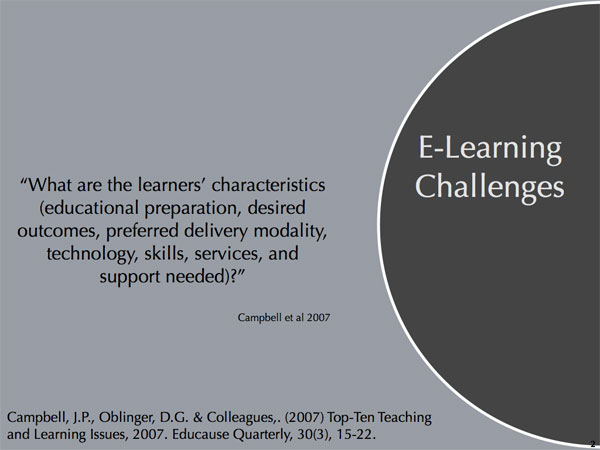
I ran across this paper from Educause Quarterly by John Campbell and Diana Oblinger about the top ten challenges for teaching and learning for 2007. I guess they had to wait until 2007 was almost over before knowing what those challenges were because this didn't appear until November.
I was particularly struck by issue number four: "Selecting Models and Strategies for E-Learning". One of the key questions posed there was "What are the learners' characteristics (educational preparation, desired outcomes, preferred delivery modality, technology, skills, services, and support needed?" This was intended for general e-learning, but I think it's even more important to e-learning for the disabled.
Range of Disabilities
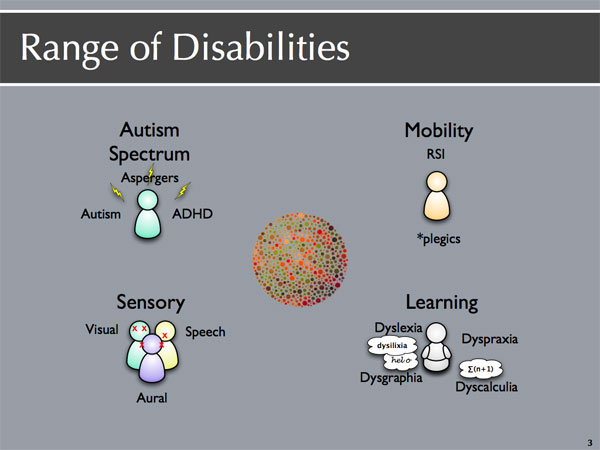
There's a wide spectrum of disabilities that people might present with in higher education, especially with e-learning.
Many people, when thinking about disabilities, probably think of the more common, visible disabilities in the lower left-hand quadrant: sensory disabilities, like hearing impairments, visual impairments -- including colour blindness -- and speech impairments; or perhaps they think of the various kinds of mobility impairments: quadriplegics or paraplegics.
I'd rather focus on the more unusual or "invisible" disabilities. For example, I think we should include RSI -- repetitive stress injury -- as that's a mobility disability that's affecting an increasing number of people and presents issues for e-learning.
In the upper left-hand corner, I have the autistic spectrum, with Aspergers, autism, and attention deficit hyperactivity disorder, which I have myself. These bring with them their own requirements for information presentation and processing.
Finally, in the right-hand quadrant, the various learning disabilities, many of which may co-occur with disorders in the autistic spectrum: dyslexia, dyscalculia -- difficulty in learning or understanding mathematics -- dysgraphia--difficulty in the ability to write -- and dyspraxia, the partial loss of the ability to coordinate and perform certain purposeful movements and gestures.
I have specifically omitted mental disorders like bipolar disorder and depression, as they don't affect the presentation or access to learning so much.
Challenges (1)
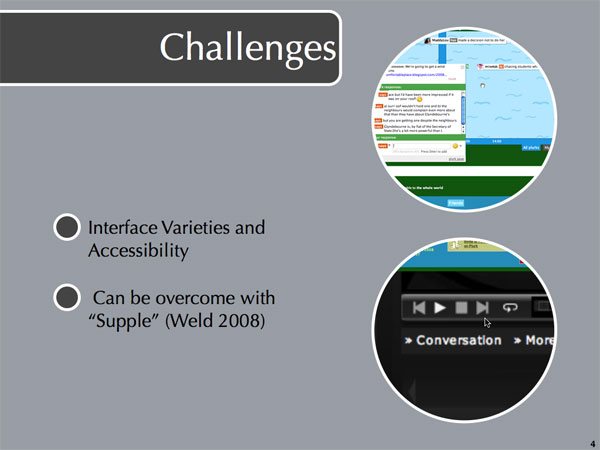
So what are some of the challenges affecting the disabled in e-learning? One of them is the variety of interfaces and how accessible those interfaces are to various disabilities.
At the top we have Plurk, a microblogging service like Twitter, where you have 140 characters to explore what you're doing now. Unlike Twitter, Plurk is threaded (see the threaded example inset) and is displayed on a timeline. The interface, though, is quirky and difficult to use by non-disabled on portable devices, like the iPhone. If you had a mobility problem, with all the fine clicking and moving of the mouse to choose between different threads, Plurk would be very difficult to use. Twitter, in comparison, is very linear, and accessible to people on different devices and those using assistive software.
On the bottom is Seesmic's interface. Seesmic is a video blogging or a video conversation site.
Some of the interface issues can be overcome by better design. Unfortunately, we don't always have control over the design of materials used in e-learning. I just read about a new adaptive interface system called Supple, presented by Dan Weld et al. at this year's AAAI convention in Chicago in July. If you've ever used a Palm Pilot, you might recall that the first thing it asks you to do is tap the screen in various corners, so it can calibrate how accurate you are pointing on the screen with the stylus. Supple does something similar but with user interfaces and then can rearrange the interface elements to accommodate motor problems, for example. Dan Weld's team indicated that one of potential application areas for this was web pages and I know that Niall Sclater at the Open University is already interested in it for exactly that.
Challenges (2)
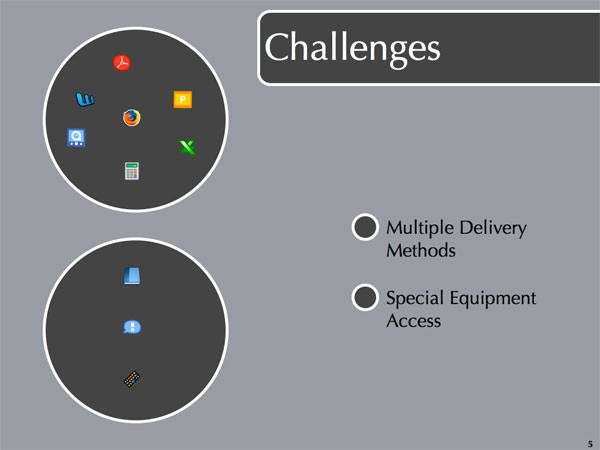
Closely related to different interfaces is the multiple methods of content delivery possible in e-learning: slides, spreadsheets, PDF documents, word processing documents, and audio-video presentations. Each of which presents its own accessibility issues.
Some of them require special equipment, like book readers or screen readers or mobility assist devices to aid in pointing, typing, or clicking. Some of this equipment is very expensive, so there's an issue of financial accessibility as well.
Challenges (3)
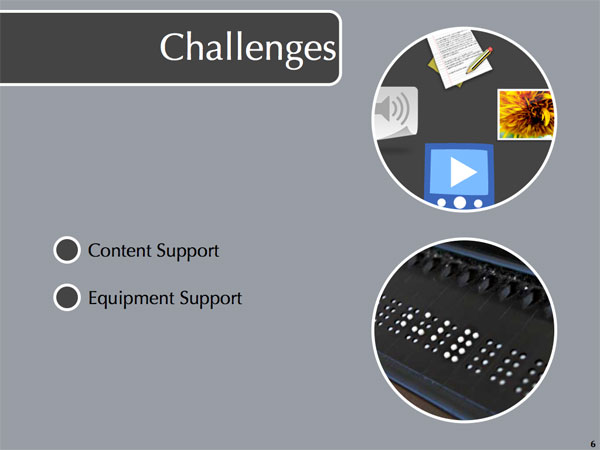
Once media accessibility has been addressed, there are still the traditional issues around content support. This is a challenge that all students face.
Disabled students may also have a challenge in finding adequate support for their specialized assistive software or equipment. At the Open University, a student's tutor is often their first port of call for problems, so it's not unreasonable to expect some ideas about how to solve common technical issues or know where to point students for help.
Challenges (4)
More so than other students, disabled students are more likely to suffer from emotional issues related to returning to study or taking university courses via distance education. That might include doing too much or too little, perfectionism (not that I know anything about that!), not wanting to be a special case, confidence, and self-image problems. The last three are particularly common.
Challenges (5)
A familiar problem to everyone in distance education is that of students feeling isolated. This is a not-so-familiar problem for undergraduate students at traditional bricks-and-mortar institutions and very familiar for many disabled who may have spent a lifetime already feeling "different" and left out.
The good news here is that a lot of the isolation can be overcome with Learning 2.0, a topic I'll return to later on in the presentation.
Modes of Delivery
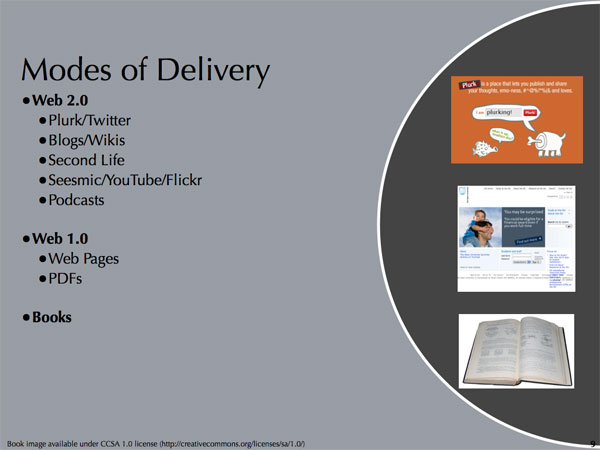
E-learning modes of content delivery can be broken down into three areas: Web 2.0, Web 1.0, and printed materials. Web 2.0 can be thought of as the new, more interactive types of web site and online activities: Plurk/Twitter, blogs and wikis, Second Life, the video sites like Seesmic, YouTube, and Flickr. It can also include things like podcasts, an area the Open University has recently joined in partnership with iTunes U. These allow people to create content, often collaboratively, and then easily share it with others who may then modify it or comment on it.
Web 1.0 is typified by traditional, static web pages, converted PowerPoint presentations, and PDF documents. The possibilities for interactivity are very minimal. This is a very traditional and common way of presenting material online and probably not about to be supplanted completely by Web 2.0 applications in the near future.
And, as much as we'd like to claim we're a paperless university, the truth of the matter is we still have books and other printed materials. Web-based content can be made accessible sometimes with screen readers. Even with book readers, though, sometimes printed content is inaccessible. For example, on TT281, our course text had commentary in inset blocks and code on the rest of the page. Our blind student was unable to "read" the book satisfactory because of the layout. We contacted the publisher but, because of when we were first alerted to the problem, there was insufficient time to have something appropriate made available.
I just read about two recent initiatives by JISC TechDis, the Publishers Association, and the RNIB that might help in such situations. The first is "Publisher Lookup UK" where participating publishers provide contact addresses for having special arrangements of their materials made available. The second initiative is a guide to obtaining textbooks in alternative forms, providing advice on where to go, what to expect, and what questions to ask.
Long-Tail Learning
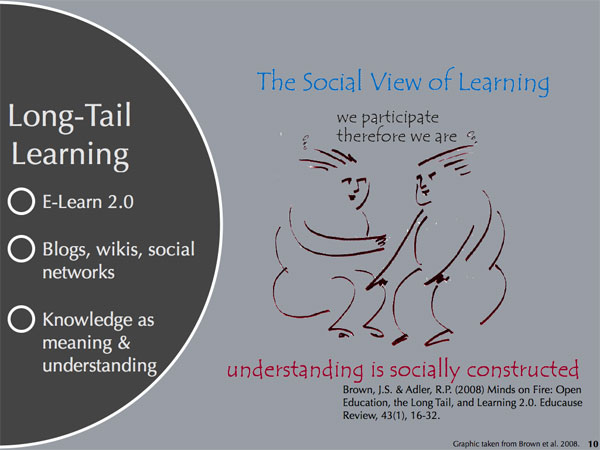
Wikis, blogs, and social networking sites can help form the backbone of Learning 2.0, synonymous with long-tail learning. I first read about this back in January this year in another Educause article called "Minds on Fire: Open Education, the Long Tail and Learning 2.0". In this article, Brown et al. discuss how 80% of sales in a bookstore come from 20% of the titles. That's the fat part of the "tail." Amazon, Chapters, and Borders turned that around by offering a huge selection, so large that the majority of their sales actually comes from the "long tail" of the sales curve. In education, content delivery is the fat part of the "tail" but the "long tail" comes from people's interactions with learning and knowledge.
So in "long-tail learning", Brown says that learning is a social activity and that understanding is socially constructed. This is contrasted with E-Learn 1.0, which was Cartesian learning, where knowledge is substance. That is, teachers impart "knowledge" to their students who somehow "learn it". Learning is a commodity to be boxed up and distributed.
Social networks are a strong, positive force here, especially for the disabled as they're not restricted from participating by their disabilities, unlike possibly real-world social networking. We know that students benefit from study groups, because they engage more with the material. Blogs, wikis, and social networks offer a powerful opportunity for the disabled.
E-Learn 2.0 Opportunity
I think e-learning for the disabled isn't so much a challenge as an opportunity to provide a level playing field. However, that opportunity will only be there if we remember certain things. The first is to adhere to standards, like those proposed by the W3C Web Accessibility Initiative and WebAIM. Stay away from technologies that are accessibility unfriendly, like Flash, or provide alternative access to the content if it's core to the learning experience.
It's an opportunity if we focus on accessibility, both in terms of access to the content and in terms of the content itself. I haven't spoken a lot about web-based accessibility as I teach courses here at the Open University and author course content on it, discussed in my original application and in my CV, but I will add the following comments about content: write clearly and comprehensibly, and use white space appropriately; engage in sensible paragraph planning paragraphs for those with attentional or focussing difficulties. Accessibility isn't just about the disabled. Paying attention to these details benefits everyone.
Finally, it's an opportunity if we remember our primary motivation:
Primary Motivation
Teach, yes, but also foster a willingness (and ability) to learn and to continue to learn.
In conclusion, lifelong learning is compatible with long-tail learning. Social networks can go on long after the "course" ends. E-learning does have challenges for the disabled, but it's also a great opportunity to move forward by using E-Learn 2.0 and Web 2.0 in a focussed, accessible way.
Contact Details
Michelle A. Hoyle -- August 19th, 2008.
http://einiverse.eingang.org/
eingang AT sussex DOT ac DOT uk
Downloadable Resources:
- A4 PDF Version of H810 Interview Talk on Challenges Affecting the Disabled in E-Learning (1.5 MB)
August 02, 2008
Using OmniDazzle in Apple Keynote Presentations
I was recently recording a narrated Keynote presentation for display on the web and found myself wanting to use the OmniGroup's very cool OmniDazzle screen effects program in conjunction with Apple's Keynote presentation package. Unfortunately, by default, Keynote doesn't play well with other applications, as it intercepts all the keyboard commands. You can, however, convince it to play nicely very easily. Here's what you need to do.
Open the Keynote preferences. This is in the program menu (or Apple/Cmd ,).
Go to the "Slideshow" tab.
Ensure that "Allow Exposé, Dashboard and others to use screen" is enabled with a checkmark beside it.
That's it! Now you can use OmniDazzle in your Keynote presentations.
June 14, 2008
In progress!
I’m currently working on my HEA accreditation again. I told the facilitator that this would be the year I would succeed. Unfortunately, I’m rapidly running out of time. I need to make a huge push next weekend to get the bulk of it done and out the door. It’s been so low-priority that it keeps falling off my radar.
February 14, 2005
More Marking Madness
If I don't finish my marking very soon, they're going to kill me. The phone calls are increasing. With the ADD, though, I just have this overwhelming sense of guilt, failure, and frustration. More about that later. Something must be done.
Anyway, I have a plan. My Sweetie is helping me do some of the grunt administrative work that's required (filling out the forms, uploading some of the files to each project directory to help check the functionality, checking for missing/incorrect project directories, etc.). While Sweetie's doing that, I'll put in a big push to finish assessing the remaining reports (22). Then, to take a break, I'll fill in the scanning sheets for all the report-related marks for each student, and then have a go for a bit at assessing the coding parts of the projects.
The coding part is cognitively easier to assess for me as it's definitely more black and white (it works/it doesn't work; it's written well/it's written poorly). It still takes time to do, though, because you have to check through all the functionality for various points and write up the notes.
With luck, proper use of my ADD medication, and SweetieSupport, I hope to get it all in tomorrow evening's post. I'll let you know how I make out.
February 08, 2005
Marking Madness and Motivation
Project marking has to be one of the banes of my existence. Right now I'm working on grading an end of course project consisting of a coding component and a report. The coding component is fairly straightforward to do. Other than perpetual shock at the things people believe is good design/coding, it's something I can do in a reasonable amount of time. The part I have trouble with is the report.
Actually, any kind of marking where you need to subjectively weigh how close an answer is to what you want is difficult for me. Perhaps it's because Ein's have two states in many things in life: Ein/Auf, Happy/Sad, Tired/Bouncy. There's not much room for shades of grey in the EinWorld.
Anyway, that leaves me with a 53 projects to finish and I'm already two weeks late and having trouble mustering any enthusiasm for it. To be fair, I already finished doing 60 for another course which also had a coding component and a project, so I am feeling a little burnt out and I do have attention deficit disorder. Nevertheless, I promised I'd be done.
As things stand, I finished 5 completely before deciding to switch to doing all the reports first. As the reports are independent of the coding component, that's feasible. I picked the reports to do first because I like them the least and I'll feel the most relieved when they're done and the rest will be easy.
Of the 48 reports to grade, I've done thirteen. Any motivation, inspiration, or encouragement welcome!
June 04, 2004
Conceptual Change
David Jonassen visited the IDEAs lab on May 11th from the University of Missouri to present a talk on "Model-Building for Conceptual Change (Cognitive Tools in Action)". While this isn't (or so I thought) related to my own research or interests in any way, we were all encouraged to attend if possible and I'm always interested in talks about learning in general. Here, belatedly, is a synopsis of my understanding of his presentation.
The key underlying principle seemed to emphasize having people fail in their problem solving attempt at some issue because then conceptual change has a change to be engaged and then students will learn. This failure need not be catastrophic; in fact, it probably should not be, I would say, or the failure would foster a strong sense of discouragement, which is not going to get a student into the "learning zone." So, how do you put students into a non-threatening environment where they can safely experiment and fail? David Jonassen's idea was to encourage them to engage in model building which demonstrates their conceptual understanding of the problem/issue at hand. When learners build models,their understanding of the problem domain is deepened because you cannot model what you do not understand. Model building also allows you, as the instructor, to view the learner's level of conceptual change as their models evolve. It is therefore possible to assess their underlying understanding without resorting to formal assessment tests. Finally, David Jonassen suggested that model building also improves critical reasoning and thinking because model building forces the model builder to examine the process and problem solving methodology.
David Jonassen researches (among other things) the use of technology in educational settings to improve understanding. More information on his approaches to problem solving are available from on the following web site page: http://tiger.coe.missouri.edu/~jonassen/PB.htm.
I think this is some interesting research, but obviously not applicable to every learning situation. Physical processes, like volcanos, weather, chemical reactions, etc. are very appropriate for model building. Or maybe I just need to change my understanding of what constitutes a model? For example, I'm teaching students how to program in JavaScript. In a way, a program is sort of like a model and we give students programming projects where they model some kind of answer to a stated problem to demonstrate their understanding of the process. Most students do not implement the solution correctly intially, so they need to refine their understanding of the problem and its solution over several iterations. Failure is forcing them into a state of conceptual change and as they repair their assumptions and their "model" code, they are learning valuable lessons about what works and the process of both developing and fixing. I guess, in fact, I've been doing this all along; I just didn't have a name for it!
March 29, 2004
Fame & Fortune
From this week's Bulletin, newsletter of the University of Sussex.
A part-time DPhil student in the Informatics department has won a national Associate Lecturer Teaching Award from the Open University (OU). Michelle Hoyle started teaching in the OU's Faculty of Technology in May 2000 and delivers internet technology courses, primarily online. The award will be presented on 20 April at a ceremony in Milton Keynes and comes with £1,000 to be used for personal and/or professional development.
It's also on the front page of the Informatics web site at the university. It's my 15 minutes of fame this year. (-:
March 12, 2004
Bulletin Bravada
I spent part of today working on a 100-word statement that the Open University wants to put on their web site closer to the time of the award presentation ceremony. I find it ironic that, after writing two pages about myself in order to apply for the award, I have to write another 100. I find it even more ironic that I also had to suggest a sentence to put on the certificate. For the certificate, Stephen and I eventually settled on "for outstanding dedication and excellence in on-line teaching."
That still left the hundred words to be written. I reviewed my original award application material and put together the following:
Michelle focuses on Internet technology courses delivered primarily on-line. In TT280/TT281 (Design, Development, and Management/Client-Side Scripting), she provides extensive guidance through the development of supplementary course materials, in-depth FAQs, and a strong breadth of knowledge. She is a passionate communicator about technology, believing technology is sometimes only as difficult as people make it. Therefore, demonstrating a belief that students can achieve is a key to student success. In computing and technology, where women are scarce, she is a visible role model that women can succeed well in these traditionally male-dominated fields even if they have tangible weaknesses to overcome.
Once I had that out of the way, I decided I might as well go whole hog and e-mail the The Bulletin as suggested by Thufir. Not being familiar with the publication and what information they might require, I probably went overboard.
Greetings and Felicitations.
I'm a part-time D.Phil. student in the IDEAs Lab in Informatics. My supervisor suggested that I contact The Bulletin as I've just won (or will shortly be awarded) an Associate Lecturer Teaching Award for excellence in teaching at the Open University, one of two awards to be given out at the national faculty level in my faculty.
In order to win the award, I was competing against all associate lecturers in the Faculty of Technology at the Open University across the United Kingdom. While I'm not sure how many ALs that is in total, I do know that my own region has about 50-60 ALs alone in Technology. The award will be presented on the 20th of April in a ceremony at Milton Keynes and comes with a £1000 to be used for personal/professional development.
Here's a personal statement I wrote for the OU about myself with respect to the things I've done to win this award:
Michelle focuses on Internet technology courses delivered primarily on-line. In TT280/TT281 (Design, Development, and Management/Client-Side Scripting), she provides extensive guidance through the development of supplementary course materials, in-depth FAQs, and a strong breadth of knowledge. She is a passionate communicator about technology, believing technology is sometimes only as difficult as people make it. Therefore, demonstrating a belief that students can achieve is a key to student success. In computing and technology, where women are scarce, she is a visible role model that women can succeed well in these traditionally male-dominated fields even if they have tangible weaknesses to overcome.
I started at the Open University in May of 2000. During my tenure, I've taught:
M150 Feb 2004
T171 Feb 2003, Feb 2002, Feb 2001, May 2000
TT280 Oct 2002, May 2002
TT281 Oct 2003, May 2003
TU170 Feb 2002
Course Team Work TT280/TT281 Feb 2003
M150 is Data, Computing and Information
T171 is You, Your Computer, and the Net
TU170 is Learning Online: Computing with Confidence
TT280 is Web Basics: Design, Development & Management
TT281 is The Client Side of Application of Development
The award is for my efforts over the span of my OU career so far and not just the last year.
I'm not sure what else I can tell you that might be helpful or interesting. If you have any questions, please do ask. E-mail is the best way to contact me. I can provide a photo if you need one.
OK. I did get a bit unfocused and go overboard, but I find it so difficult to write positive things about myself. Whatever hapened to the adage "the Rabbi who praises himself has a congregation of one"?