November 06, 2009
WoW Survey Deisgn: Putting the Horse Before the Cart?
I've been thinking about the design of the study I want to do on motivation in World of Warcraft. My immediate approach, similar to introductory programming students, was to jump right into the meat of it and start writing survey questions instead of planning. In order to get the data you need in the study, you need to know what questions you want answered. You need to plan. Without knowing that, how can you write survey questions to elicit those answers? So what is it I want to know?
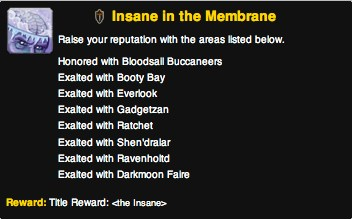
I want to say something about the kinds of motivations people have for playing World of Warcraft. Specifically, I want to enumerate factors that motivate players to persist in the game even when it involves tasks that are repetitive, boring, or seemingly impossibly long. For example, there's an achievement in World of Warcraft called "Insane in the Membrane" that gives the completer a reward of an in-game title of "The Insane." This achievement requires you to raise your reputation points with different game factions to exalted, the highest level. Generally, you need about 21,000 points to reach exalted. Points are gained by completing quests, collecting and turning in items, or sometimes killing certain types of things. If you only had to gain exalted reputation with one or two factions, this would not be difficult. However, you need to do this with eight different factions, most of which are not factions you would be accruing large amounts of reputation with during the normal course of play. To increase the difficulty, several of the factions involved have rival factions. With those factions, as you gain reputation with one, you lose reputation points with the rival faction, making the process of completing this achievement complex in addition to time-consuming. The WoWWiki (2009) page describes some strategies for completing this achievement and the complexities of the faction-rival relationships.
Most tasks players undertake are not going to be as complex, time-consuming, or mind-numbing to complete as the aptly-named "Insane in the Membrane". There are, however, many smaller day-to-day activities necessary for successful raiding or to get some particular piece of gear, such as doing daily quests to earn gold, or harvesting materials for potions or enchantments, or completing instance and after instance to get badge rewards or reputation rewards. I'm making it sound like getting achievements or gear is the be-all, end-all, but I think the situation is more complex than that. It's that hypothesis I want to verify.
Other things I would like to be able to comment on include the relationships between gender and motivation, or motivation and age, or possibly even motivation and nationality. I do not necessarily believe there will be a relationship between motivation and nationality necessarily, but how can you definitively say if you do not look for the correlation? That gives me the following questions I want answered:
- What motivates people to play World of Warcraft?
- What motivates people to persist in very boring or difficult tasks?
- Is there a relationship between gender and stated motivations? If so, what is it?
- Is there a relationship between age and stated motivations? If so, what is it?
- Is there a relationship between nationality and stated motivations? If so, what is it?
- Is there a relationship between character roles and classes and motivation?
With those six questions in mind and the original study idea of determining motivation via analysis of free-form essays about motivation, I can now go ahead and develop the specific survey questions that will help elicit data to answer those questions. Going back to considering my approach-whether I should start with planning versus start with survey question-it was not as clearcut as I expected. By starting with some potential survey questions and then thinking about the answers I would get from them, I gained a better idea about what answers I wanted, a kind of iterative development process. Sometimes putting the horse first helps you know where and how to put the cart!
References:
WoWWiki. (2009) Insane in the Membrane, [online] WoWWiki. Available from http://www.wowwiki.com/Insane_in_The_Membrane (Accessed November 6, 2009).
June 07, 2009
Levelling Lifelong Learning: Annual Progress Review
 I have my annual Ph.D. review meeting tomorrow afternoon. As usual, I'm more than a bit nervous, especially as I made the big step this academic year of completely dropping my former Ph.D. work and starting a brand new topic that intersects the boundaries of my three main interests: communities, learning and teaching, and Internet-enabled technologies. As part of the review process, we're asked to produce a 4-page report that explains what we've done since the last report. In your first year, this report ought to focus on your thesis proposal, although many students won't yet have one. I do have some ideas about what I want to do and how I am going to go about it. I've made an online version so that it will be indexed and easily findable by others interested in World of Warcraft and e-learning.
The 30-second summary: Examine how metaphors and game design of World of Warcraft motivate people to learn and to work, with an eye to transferring motivation, social knowledge building, and persistence to online higher education practices, like community building for lifelong learning.
Click the "More" link below to continue reading the online version of the proposal and progress report. A downloadable PDF version is also available.
What’s Gone Before
“Those who cannot learn from the past are condemned to repeat it.” - George Santayana, 1905 (2005)
I started my part-time D.Phil in 1996 with Ben du Boulay as my supervisor working on something that was a combination of information retrieval and natural language processing. For various reasons—health, job, personal reasons, etc—I intermitted a lot. As my last intermission period was expiring, I put a great deal of thought into whether I wanted to continue or not. I was loathe to completely give up everything, so I decided to continue doing a Ph.D. but unite my three lifelong interests into something more related to what I actually do: educational technology. I therefore started a new D.Phil with Dr. Judith Good in October of 2009 within my original period of registration.
Research Questions
What do I hope to discover?
There are three primary initial research questions:
- How is the “Robert and Susan” metaphor applicable to World of Warcraft and what does that gain us in understanding how to successfully encourage lifelong learning and build communities of learning?
- How does the social structure in-game and out of game resemble a community of practice? How much of a role does social knowing play in the development of expertise and the dissemination of learning? What features would it be useful to adopt when designing learning communities?
- What encourages game players to persist in learning and working, although many tasks are boring and repetitive, and to continue improving long past their current goal? How does this relate to Hagel and Brown’s (2009) “lessons”?
Roberts and Susans
Hello, my name is Susan. I am bright and highly motivated. I love to learn and to think about things. Robert is taking endless lecture notes until he gets his degree. Robert is very different than me.
The nature of universities and the characteristics of their students are changing. Students no longer arrive on the university’s doorstep intrinsically motivated to learn regardless of the teaching method employed. Tim Clydesdale, sociology professor at the College of New Jersey, describes it this way:
So this… produces a rather odd kind of student — one who appears polite and dutiful but who cares little about the course work, the larger questions it raises, or the value of living an examined life. And it produces such students in overwhelming abundance.
(Clydesdale, 2009)
Clydesdale is giving an example of a “Robert” student, from Biggs and Tang’s “Robert and Susan” student prototypes in higher education (Biggs and Tang, 2007 p.9). Susan learns in a deep way using higher order thinking skills, like theorizing, reflecting, and generating. Robert learns in a surface way using skills at a much lower cognitive level, like note-taking and memorization; he is happy do the minimum to get by. Michael Wesch comments in his recent Britannica blog essay that “…the unquestioned assumption [is] that ‘getting by’ is the name of the game” for students (Wesch, 2008), so he too has noticed the increase in the number of “Roberts”. The difference in learning approaches is expressed eloquently by the philosopher Michael Oakeshott:
There is an important difference between learning which is concerned with the degree of understanding necessary to practice a skill, and learning which is expressly focused upon an enterprise of understanding and explaining.
(quoted in Fish, 2009)
What Is Social Learning & Social Knowing
“We participate; therefore we are.” (Brown and Adler, 2008)
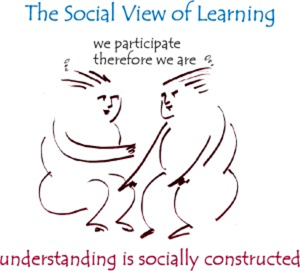
What exactly constitutes education or learning? As an educator with a computer science background, I contend that learning is different than knowledge or facts in the same way that data differs from information. Without a context, a fact is just a piece of data. It is only information or learning when it can be applied to something. Biggs and Tang (2007, p.21) are saying something similar, when they say, “The acquisition of information in itself does not bring about [effective learning changes], but the way we structure that information and think with it does.” They go on to say “education is about conceptual change, not just the acquisition of information.”
How do we elicit this conceptual change? How do we elicit this conceptual change? Biggs and Tang enumerate four precursors. The most interesting is the fourth: “[S]tudents work collaboratively and in dialogue with others, both peers and teachers.” (2008) call this “social learning” and explain that “our understanding of content is socially constructed through conversations about that content and through grounded interactions.” This fits in nicely with David Weinberger’s ideas about social knowing:
What you learn isn’t prefiltered and approved, sitting on a shelf, waiting to be consumed... Now we can see for ourselves that knowledge isn’t in our heads: It is between us. It emerges from public and social thought and it stays there, because social knowing, like the global conversations that give rise to it, is never finished.
Weinberger, 2007 p.146-147
Lifelong learning, like Weinberger’s social knowing, is never finished. It continues on outside the four walls of the classroom. It is on Twitter. It is on Facebook. It is in the student’s workplace. It is in the student’s home. It arises in conversations with the student’s friends and it arises in play. The social component, previously undervalued, is key.
Brown describes some research by Richard J. Light where Light discovered that the ability of students to form study groups was one of the strongest determinants of students’ success; it was more important than the instructors’ teaching styles (Light (2001) cited in Brown and Adler, 2008). Brown says this shifts our attention from the subject content to the learning activities and human interactions around them, which, while agreeing with Biggs, goes further by suggesting the instructor themselves is of lesser importance. Susan and Robert, becoming social, taking turns being teachers and learners together, is a powerful combination for deep learning.
World of Warcraft
The gamer’s mindset—the fact that they are learning in a totally new way—means they’ll treat the world as a place for creation, not just for consumption. This is the true impact videogames will have on our culture.” (Wright, 2006)
World of Warcraft (WoW), a massively multiple online role playing game (MMORPG) in the dungeons and dragons genre, is the most successful personal computer game ever released. As of 2008, it had more than 10 million active subscribers worldwide, amounting to 62.2% of the online gaming market (Yee, 2005).
Although it is a game, WoW, its communities, and its cultural artefacts share a number of commonalities with lifelong learning in online higher education. The first is that both have Roberts and Susans. The second is that both have structures that support ad-hoc groups where alliances shift, merge, and collapse dynamically as people come and go. The third is that both encourage the formation of communities of practice through their design and purposes (Wenger, 1999). Finally, they both, with varying degrees of success, encourage learning and collaboration that results in an ongoing learning journey continuing past the current goal.
Hagel and Brown (2009) enumerate eight “lessons” that businesses hoping to get their employees to collaborate, create, and innovate should draw from World of Warcraft:
- Reduce barriers to entry and to advance in initial stages
- Provide rich performance metrics
- Keep raising the bar
- Remember to account for and use intrinsic motivations
- Provide opportunities to develop shared knowledge not easily shared but don’t forget broader knowledge exchange
- Create opportunities for teams to self-organize around challenging goals
- Encourage frequent performance feedback
- Create an environment that rewards new dispositions
These lessons are just as applicable in fostering collaborative learning in online education and lifelong learning as in business, perhaps even more so. My mission is to discover how it applies.
Major Activities Undertaken
Making connections, forging links, firing neurons.
It was a fairly busy period. I attended a number of seminars, workshops and conferences, either in person or virtually (see Table 1). Some presentations were previously recorded.
|
October 2008
November 2008
December 2008
January 2009
|
February 2009
March 2009
May 2009
June 2009
|
Table 1: Conference, Seminars, & Workshops
List of conferences, seminars, and workshops attended virtually or in-person.
Although I have been teaching computing science and technology in higher education for over 14 years, I do not have a background or formal training in education. I decided to alleviate that in September by registering for H812: The Postgraduate Certificate in Academic Practice at The Open University, a 60-point course in their online distance education masters program. Upon completion, I will have my Higher Education Academy accreditation for teaching in HE. Prior to that point, I had already agreed to teach H810: Accessibility Online Learning: Supporting Disabled Students, another course in the online distance education program. It was, in fact, applying for a teaching post for this course that led me to decide to rekindle my Ph.D. by changing to something I already do: educational technology.
Teaching a pilot course is always a lot of work, especially one where you have a background in half the content—technology—but not necessarily in the other half—educational pedagogy. I spent quite a lot of time in the fall working through the course on my own, just ahead of my students. I have also been dipping into the material for another brand new course: H800: Technology-Enhanced Learning: Practices and Debates, a new course that just started this year, co-authored by Gráinne Conole. What all these courses have in common is exposure to different ideas in educational technology and pedagogy. From the accessibility and e-learning course, I picked up ideas about Wenger’s communities of practice, which I have incorporated into my thinking. From H800, I have been exploring ideas about digital natives and “the Google Generation”. From H809: Practice-Based Research in Educational Technology, I’ve acquired some guided readings on ethnography as a research method, which I suspect is one of the types of study I need to use for studying behaviour within World of Warcraft.
It is the course I am actually taking that has proven the most useful, though, as it has a guided introduction to many pedagogical theories, especially constructive alignment from Biggs & Tang (Brown & Adler, 2008). That material was directly usable in the book chapter proposal I submitted earlier this year, the bulk of which is now incorporated into this document.
For the second assignment, I did some analysis on a course I chair, examining how outcomes-based learning and teaching, a kind of constructive alignment, has not been properly employed in the course design and how that has resulted in students failing to persist and pass the course. That piece of research served as the basis for my recent “Making Connections” conference presentation. That assignment also included ideas about Robert and Susan and the increase in the number of Roberts, as well as the current nature and purpose of universities. Building on that analysis and inspired by Constance Steinkuehler’s work on scientific literacy practices in World of Warcraft communities, I developed an activity intended to improve academic literacy practices in my Open Source third-year students, and then evaluated the effect on demonstrated practices in their course practices; I presented some of those findings during my “Making Connections” talk, The Nutcracker Effect.
That Open Source course I chaired this year has fed into my thinking in other ways too as a direct result of my ongoing fascination with the ideas of John Seely Brown. In a keynote speech I watched, he was comparing evaluating the influence of “tinkering” on Open Source and how that ties into learning. One of my students innocently made a comment about how Open Source is very similar to learning too. It got me thinking about how tinkering is directly applicable to problem-based learning as well as deep learning, both topics related to activities I see taking place in World of Warcraft and ones I want to encourage in communities of practice for learning.
I do not spend time looking for relevant course materials. In actuality, useful material from other courses came to my attention because of people in my online personal learning networks with whom I interact via Twitter and Plurk primarily. That includes people like Gráinne Conole (OU), Martin Weller (OU), George Siemens (Manitoba), Bryan Alexander (NITLE), Howard Rheingold (Stanford), Steve Wheeler (Plymouth), Tony Hirst (OU), and Alan Cann (Leicester). I am also connected and in regular contact with a number of other Ph.D. students and researchers around the world, both in e-learning and games research.
Not all of the seminars and workshops I attended were immediately obviously applicable, although people I have met at them have fed into my work, like K. Faith’s Lawrence’s and her Ph.D. work on fan fiction and artifact production in LiveJournal communities (2008); or practices that encourage motivation and persistence from an Open University staff workshop. Ben du Boulay’s motivation reading group was also very helpful by picking out important theory papers from psychology and cognitive science in motivation, a topic I did not initially realize was of interest until I started regularly attending those meetings. Now motivation is a key element of what I want to investigate.
| Activity | Result |
|---|---|
H812: Postgraduate Certificate in Academic Practice |
2 essays; material for book chapter proposal; a conference presentation; constructive alignment; Roberts and Susans |
H810: Accessbility in Online Learning |
blog postings; introduction to communities of practice; inclusion & nature of universities |
H800: Technology-Enhanced Learning & Practices and H809: Practice-Based Research in Educational Technology |
Digital natives; Google generation; tinkering & J.S. Brown; ethnography as a research method |
Book chapter proposal |
Rejected but served as the basis for this document and thesis proposal; thesis topic. |
Seminars, workshops, conferences |
Ideas and people |
Twitter and Plurk |
Ideas, people, resources, discussion, and community. |
Table 2: Major Activities Summary
Activities and their outcomes
Progression and the Future
There’s much left to explore.
My immediate plan is to complete a literature review and formal thesis proposal by the end of October. That means a summer spent reading. I have some good starting points, both in e-learning, motivation, and game-related to learning areas, including Constance Steinkuehler’s World of Warcraft literacy research and Bonnie Nardi’s work. There is also more to read on John Seely Brown’s ideas on information spaces, learning, and tinkering. I feel I am in a good position to start and make good progress on that without getting too lost. I also can draw upon the advice and recommendations of others in my personal learning network, if need be.
I am anticipating at least three studies to complete my Ph.D. work. The first is a beta study to test out the research and data methodology for a larger-scale study in World of Warcraft. At this point, it is not clear whether the study will be an ethnographic study occurring in World of Warcraft directly or some other kind of research, like discourse analysis, on related artifacts like forums and web sites. That will be more evident after the thesis proposal has been written and I have a clearer idea of what specific questions I want the study to answer, perhaps after consultation with Dr. Ruth Woodfield from Sociology. However, I do know that I am looking for metaphors and systems for motivation and persistence that can be transported into an e-learning communities of practice environment. The second study would be the actual large-scale study intended to gather sufficient data to answer the posed questions.
The third study would take the hypothesis of motivation and persistence gained from the World of Warcraft studies and apply it to a subject online student population for positive improvements. I hope to facilitate something through my current connections at the Open University. This would be a good route as the student population in my undergraduate courses are quite large and could be divided into control and experimental groups. If an OU group is not possible, using a smaller group from Dr. Good’s online e-learning cohort might work. I am in the process of sounding out various people already at the Open University as to how I would go about obtaining permission to do that.
I am also actively looking for small JISC grant projects in related areas that I can apply for on my own. Dr. Tony Hirst (OU) has apparently figured out a way by which universities can be bypassed when applying for JISC funds, thus avoiding the universities annexing up to half for fixed costs out of an already small amount. He has already done this with one of his own projects (Winn, 2009), but I will admit he is in a better position than I am to pull it off. Still, it does not hurt to look and to try.
In addition to obtaining funding, another benefit of research grants is that they expect output, usually in the form of published papers or other documents. That would tie nicely into my plans to do a thesis comprised of a collection of papers (published or unpublished) as already permitted in Psychology at Sussex. With my attention deficit disorder, I feel this approach will be a lot easier for me to manage, as individual papers are self-contained and smaller units. My plan is to publish several papers. The initial research questions I have already could form at least one and the two major studies another two. The argument would be that published papers have already undergone some sort of peer review and, by publication, obtained far wider public exposure than most Ph.D. theses ever get. Dr. Good and Dr. Whitby are responsible for making this possible (or attempting to do so) on the departmental side. I would like to see the option available to everyone, but I am confident I should be able to get it as a reasonable accommodation for my disability.
My intention is to complete by spring of 2011. I will include a tentative timeline of things to be done and when in my thesis proposal at the end of October. In order to complete in 2011, I will need to make a change to my registration status as I am officially out of time in January 2010. I spoke to the postgraduate advisor at the beginning of the year. She believed the department would work with me to either restart my registration period or extend my current one. I am in the process of trying to get that sorted prior to the decommissioning of the school later this summer.
References
Biggs, J. & Tang, C. (2007) Teaching for Quality Learning at University, 3rd edition, Maidenhead, UK, Open University Press.
Blandeburgo, B. (2009)> ‘Activision “WoWs,” But Where’s Wireless?’, The Game Trade Journal, blog entry posted March 4, 2009. Available from: http://www.gametradejournal.com/2009/03/activision-wows-but-wheres-wireless.html (Accessed March 9, 2009).
Brown, J.S. & Adler, R.P. (2008) ‘Minds on Fire: Open Education, the Long Tail, and Learning 2.0’ Educause Review, 43 (1), [online] Available from: http://connect.educause.edu/Library/EDUCAUSE+Review/MindsonFireOpenEducationt/45823 (Accessed August 22, 2008).
Churches, A. (2008) Bloom’s Digital Taxonomy, [online] PDF. Available from: http://edorigami.wikispaces.com/Bloom’s%20Digital%20Taxonomy (Accessed January 20, 2009).
Clydesdale, T. (2009) ‘Wake Up and Smell the New Epistemology’, Chronicle of Higher Education, January 23, 2009, [online]. Available from: http://chronicle.com/free/v55/i20/20b00701.htm (Accessed January 23, 2009).
Fish, S. (2009) ‘Think Again’, The New York Times, blog entry posted January 18, 2009. Available from: http://fish.blogs.nytimes.com/2009/01/18/the-last-professor/ (Accessed January 22, 2009).
Hagel, J. & Seely, J.S. (2009) ‘How World of Warcraft Promotes Innovation’ Business Week Online, January 14 [online] Available from: http://www.businessweek.com/innovate/content/jan2009/id20090114_362962.htm (Accessed January 19, 2009).
Krathwohl, D.R. (2002) ‘A Revision of Bloom’s Taxonomy: An Overview’ Theory into Practice, 41 (4), [online] Available from: http://www.informaworld.com/smpp/content~db=all?content=10.1207/s15430421tip4104_2 (Accessed January 12, 2009).
Lawrence, K.F. (2008) The Web of Community Trust - Amateur Fiction Online: A Case Study in Community Focused Design for the Semantic Web. Ph.D. thesis, University of Southampton.
Weinberger, D. (2007) Everything Is Miscellaneous: The Power of the New Digital Disorder, New York, USA, Holt Paperbacks.
Santayana, G. (2005) The Life of Reason: The Phases of Human Progress, Project Gutenberg, [online] Available from: http://www.gutenberg.org/files/15000/15000-h/15000-h.htm
Wenger, E. (1999) Communities of Practice: Learning, Meaning, and Identity, Cambridge, UK, Cambridge University Press.
Wesch, M. (2008) ‘A Vision of Students Today (& What Teachers Must Do)’, Britannica.com, blog entry posted October 21, 2008. Available from: http://www.britannica.com/blogs/2008/10/a-vision-of-students-today-what-teachers-must-do/ (Accessed October 21, 2008).
Winn, J. (2009) ‘JISCPress: Developing a Community Platform for the JISC Funding Process’, The Learning Lab, blog entry posted June 5, 2009. Available from: http://joss.blogs.lincoln.ac.uk/2009/06/05/jiscpress-developing-a-community-platform-for-the-jisc-funding-process/ (Accessed June 5, 2009).
Wright, W. (2006) ‘Dream Machines’, Wired, 14.04
Woodcock, B.S. (2008a) MMOGCHART.Com, [online]. Available from: http://www.mmogchart.com/ (Accessed March 8, 2009).
Woodcock, B.S. (2008b) An Analysis of MMOG Subscription Growth: Version 23.0, [online]. Available from: http://www.mmogchart.com/analysis-and-conclusions/ (Accessed March 8, 2009).
Yee, N. (2004) Player Demographics, [online] The Daedalus Project. Available from: http://www.nickyee.com/daedalus/gateway_demographics.html (Accessed March 9, 2009).
Yee, N. (2005) ‘WoW Basic Demographics’, The Daedalus Project, blog entry posted July 28, 2005. Available from: http://www.nickyee.com/daedalus/archives/001365.php (Accessed March 9, 2009).
Contact Details
Michelle A. Hoyle -- June 7, 2009
http://einiverse.eingang.org/
eingang AT sussex DOT ac DOT uk
Downloadable Resources:
-A4 PDF Version of Levelling Lifelong Learning: Progress Report 2008/2009 (612 KB)
February 13, 2009
What Am I Doing? The Two-Sentence Summary
For the last several months, I've been engaged in various activities all with the same intended goal: generate a concrete idea about what specifically I want to look at in Michelle 2.0, my new Ph.D. I've been mind mapping, writing permutation programs, brainstorming, discussing, writing essays, and writing thesis proposal plans. The most successful thing was probably having to sum up what I'm doing briefly for a visitor to the research lab's weekly meeting this morning. While it answers the Twitter question "What are you doing?", it's too long to fit in 140 characters but it does fit into 40 words.
Q: What are you doing?
A: Looking at how metaphors and game design of World of Warcraft motivate people to learn and to work, with an eye to transferring motivation, social knowledge building, and persistence to online distance education practices, like teaching and community building.
There you go. Now we all know!
I'd just like to point out, though, that my ability to verbalize it so coherently and concisely is a result of all the other writing and thinking I've been doing. If I hadn't written the essay in November and the extremely rough paper outline for a thesis proposal on Sunday, the idea would not have coalesced so concretely. Time, background cogitation and serendipity seem to be strong features of my new Ph.D. For me, not knowing exactly what I wanted to do, has been sharply focussed by talking, reading, writing, and going to seminars. It doesn't matter what the seminars were or how relevant. It's amazing how much I've drawn out of the motivational reading group I was participating in when I didn't even know I was interested in motivation. Connections appear where you least expect them. The important thing is to take the leap and do.
What Am I Doing? The Two-Sentence Summary
For the last several months, I've been engaged in various activities all with the same intended goal: generate a concrete idea about what specifically I want to look at in Michelle 2.0, my new Ph.D. I've been mind mapping, writing permutation programs, brainstorming, discussing, writing essays, and writing thesis proposal plans. The most successful thing was probably having to sum up what I'm doing briefly for a visitor to the research lab's weekly meeting this morning. While it answers the Twitter question "What are you doing?", it's too long to fit in 140 characters but it does fit into 40 words.
Q: What are you doing?
A: Looking at how metaphors and game design of World of Warcraft motivate people to learn and to work, with an eye to transferring motivation, social knowledge building, and persistence to online distance education practices, like teaching and community building.
There you go. Now we all know!
I'd just like to point out, though, that my ability to verbalize it so coherently and concisely is a result of all the other writing and thinking I've been doing. If I hadn't written the essay in November and the extremely rough paper outline for a thesis proposal on Sunday, the idea would not have coalesced so concretely. Time, background cogitation and serendipity seem to be strong features of my new Ph.D. For me, not knowing exactly what I wanted to do, has been sharply focussed by talking, reading, writing, and going to seminars. It doesn't matter what the seminars were or how relevant. It's amazing how much I've drawn out of the motivational reading group I was participating in when I didn't even know I was interested in motivation. Connections appear where you least expect them. The important thing is to take the leap and do.
October 17, 2008
The Times They Are A-Changin'
Something is not the same
I'm through with playing by the rules
Too late for second-guessing
Too late to go back to sleep
It's time to trust my instincts
Close my eyes and leap."
Lyrics and music by Stephen Schwartz
Sometimes you have to be smart enough to realize that the battle you're fighting isn't one you are going to win or even sometimes one you want to win. I walked into my supervisor's office in September and told him I was throwing away all my document similarity and agents work from the last twelve years.
I took the leap.
I landed in a new Ph.D. project in the same research group at the University of Sussex but in a completely different area. Good bye, information retrieval. Hello, educational technology.
Not only do you have to be smart enough to realize you can't win at some things, you have to be smart enough to realize that you should be doing what you're already good at and have been doing. My seemingly impetuous decision is not as foolish as it might sound. I have been working in online distance education using educational technology at the Open University since 2000. I am based in a group at the University of Sussex studying how technology can be used to scaffold learning. I am in daily contact with other educational technologists, practitioners and researchers, via Twitter and other social networks on a daily basis. I belong to that community. It's time to trust my instincts and do what I am.
Welcome to Michelle 2.0.
October 13, 2005
Some Magic with Merlin
When I was preparing for my thesis committee meeting earlier this year, one of the things I did was prepare a project timeline. In order to do that, I spent ages testing out project management software again, because working with FastTrack Scheduler was so frustrating and unrewarding. After a lengthy but rushed evaluation of several products, I ended up going with a relatively new product called Merlin from a German company. While Merlin isn't perfect, it at least wasn't frustrating to use and its import/export facilities meant that I could overcome some of its reporting deficiencies through the judicious application of other applications.
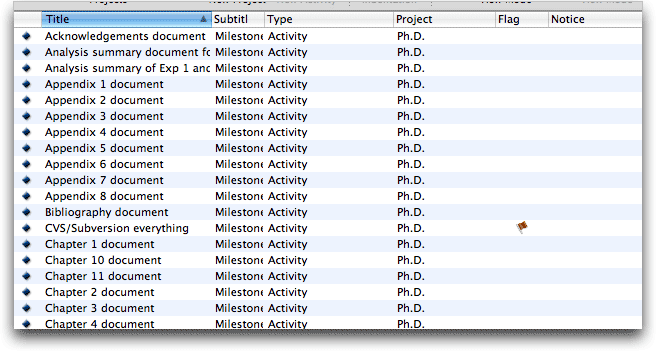
The biggest reporting deficiency I immediately found was that I wanted to produce a nice list of milestones organized by month and year, so that it was easy to see at a glance what deliverables I was supposed to have at any given point. The first sticky bit was that I didn't have a way to do a search for just the milestones in Merlin. I could define milestones, yes, but the interface didn't allow me to search for them. To overcome that, I had to manually add the word "Milestone" as a comment to all the milestones. When you do a "search", you can then say "Milestone" and a list of Milestones will be retrieved as a "report". Unfortunately, this is pretty ugly and useless because it didn't include any of the date information, although you could see if something was late (red flag):
So instead I hit upon the idea of creating a "workspace view" for the Milestones which included the kind of information I would need to produce a nicely formatted list: The milestone activity name, its end date (due date), its "path", and its "subtitle" (the comment field which says "Milestone". The "path" is the a string showing the outliner path of a specific activity. For example, it's writing a chapter in the thesis, the path is "Ph.D./Thesis Writing/Chapter 1" where "Ph.D." is the overall project name, "Thesis Writing" is the enclosing activity container, and "Chapter 1" is the actual activity. Here's what this view looks like:
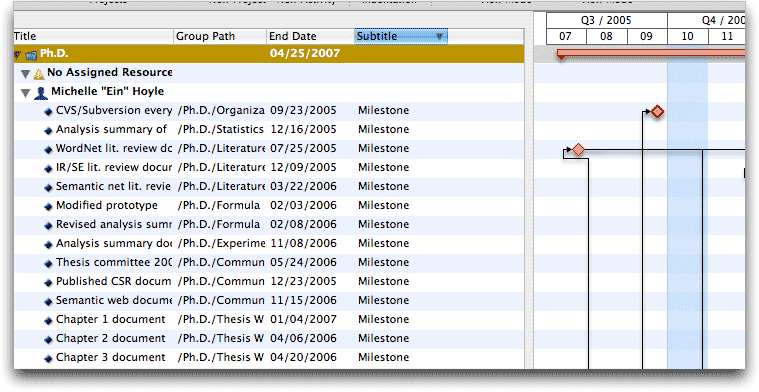
Unfortunately, there wasn't a way to only include just the Milestones. So if you go down the list, it actually includes everything, but the other items don't have a Subtitle of "Milestone."
Once you have this view, you can export the view as a comma-separated values file. Actually, it's a semicolon-seperated values file, but let's not be too picky. That gives you something that looks like:
Title;Group Path;End Date;Subtitle
Ph.D.;;04/25/2007 15:00;
No Assigned Resources;;;
"Michelle ""Ein"" Hoyle";;;
CVS/Subversion everything;/Ph.D./Organization;09/23/2005 17:00;Milestone
Analysis summary of Exp 1 and Exp 2;/Ph.D./Statistics;12/16/2005 17:00;Milestone
WordNet lit. review document;/Ph.D./Literature Review;07/25/2005 18:00;Milestone
IR/SE lit. review document;/Ph.D./Literature Review;12/09/2005 16:00;Milestone
Semantic net lit. review document;/Ph.D./Literature Review;03/22/2006 18:00;Milestone
Modified prototype;/Ph.D./Formula Work;02/03/2006 13:00;Milestone
Revised analysis summary document for Exp 1 & 2;/Ph.D./Formula Work;02/08/2006 18:00;Milestone
Analysis summary document for Exp 3;/Ph.D./Experiment 3: Semantic Web;11/08/2006 18:00;Milestone
Thesis committee 2006 report;/Ph.D./Communication/Thesis Committee 2006;05/24/2006 17:00;Milestone
Published CSR document;/Ph.D./Communication/CSR Paper 2005;12/23/2005 15:00;Milestone
Semantic web document;/Ph.D./Communication/Semantic Web Paper 2006;11/15/2006 16:00;Milestone
Other: Copyright Clearance;/Ph.D./Thesis Writing;02/04/2007 11:00;
Prepare Appendix 7;/Ph.D./Thesis Writing/Appendices/Appendix 7: NLP tagging;06/01/2006 17:00;
Prepare Appendix 5;/Ph.D./Thesis Writing/Appendices/Appendix 5: Exp. 3 Documents;11/23/2006 18:00;
Prepare Appendix 4;/Ph.D./Thesis Writing/Appendices/Appendix 4: Exp. 2 Machine/people data;06/22/2006 17:00;
When I originally did this, I was having trouble with the date format in Merlin. Merlin was using European date formats and everything else in my computer was using the System-defined date method of mm/dd/yyyy and not dd/mm/yyyy. Before I could use this data elsewhere, I needed to fix the dates, so one of the first patterns I wrote was one to strip out the times and flip the month and day fields around. I eventually fixed that, so the flipping isn't necessary, but one of the first steps in a BBEdit Text Factory is still to strip out the times. Before that, though, I need to remove the non-milestone entries. They're the ones that end with a ; instead of ";Milestone". The regular expression pattern "(^.*;\r)" will search for lines that end with a ; and replace the entire line. When I used "(^.*;$)", I ended up with multitudes of empty lines.
The next thing to do is get rid of the ";". If I import it into another application, tabs would be better than ;. The pattern ";" replaced by "\t" solves that admirably, leaving the file more or less ready for the bulk of the manipulations that need to occur. Here's an annotated list of the operations that the BBEdit Text Factory performs:
| Step | Search Pattern | Replace Pattern | Comment |
|---|---|---|---|
| 1 | (^.*;\r) | "" | Remove non-milestone entries from the list. |
| 2 | ; | \t | Separate the fields with a tab instead of a semicolon |
| 3 | (\d{2})\/(\d{2})\/(\d{4}) \d{2}:\d{2} | \1\/\2\/\3 | Remove the timestamp. Could be shorter! |
| 4 | (\s)\/Ph.D.\/([^\/\t]+)(\t\d) | \1\2\3 | Split apart path info to grab overall activity type |
| 5 | (\s)\/Ph.D.\/([^\/]+)\/.*(\t\d) | \1\2\3 | Something similar to above but works on remaining ones |
| 6 | \tMilestone | Remove Milestone comment as not needed | |
| 7 | \t$ | Removing any trailing tabs |
Before doing all this, I need to manually remove the first four lines at the top of the file. I was able to write a regular expression to find/remove the first four lines, but then it would "replace all" What I needed was a "replace once" action, but that doesn't seem to be a possibility in BBEdit at the moment. I should probably suggest it. The end result was something like this:
CVS/Subversion everything                              Organization                09/23/2005
Analysis summary of Exp 1 and Exp 2                    Statistics                  12/16/2005
WordNet lit. review document                           Literature Review           07/25/2005
IR/SE lit. review document                             Literature Review           12/09/2005
Semantic net lit. review document                      Literature Review           03/22/2006
Modified prototype                                     Formula Work                02/03/2006
Revised analysis summary document for Exp 1 + 2        Formula Work                02/08/2006
Analysis summary document for Exp 3                    Experiment 3: Semantic Web  11/08/2006
Thesis committee 2006 report                           Communication               05/24/2006
Published CSR document                                 Communication               12/23/2005
Semantic web document                                  Communication               11/15/2006
Chapter 1 document                                     Thesis Writing              01/04/2007
Chapter 2 document                                     Thesis Writing              04/06/2006
Chapter 3 document                                     Thesis Writing              04/20/2006
Chapter 5 document                                     Thesis Writing              06/14/2006
Chapter 6 document                                     Thesis Writing              07/12/2006
The new version of OmniOutliner Pro is quite cool. They added many new column types to it to help people use it for things like David Allen's Getting Things Done and building to-do lists with due dates, etc. As a result, it was possible to build an OmniOutliner document which contained months and years entered as top-level items with "due dates" as the first of the appropriate month/year and tell it to sort the document based on the "due date" column. Any items you added with due dates would then be sorted correctly. I set up a template with just this information in and formatted and spaced out the way I wanted. Then I could paste in my BBedit output. I'd end up with something like:
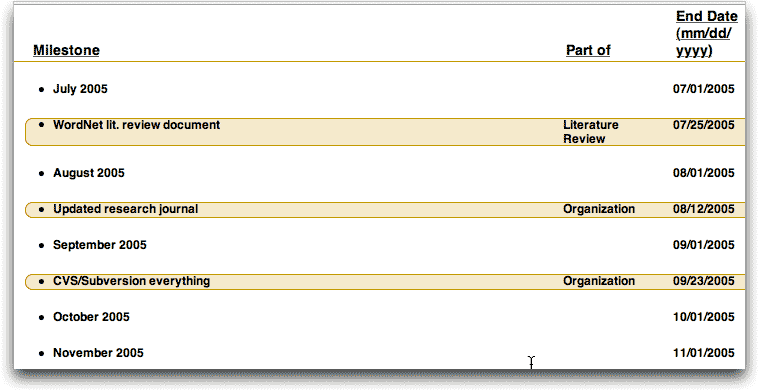
Everything was at the same level. However, everything I'd just pasted in was still selected. I discovered that if I just hit the tab key, it made all the selected items subordinate to the items above them. Since the items above them were always the month/year headers, I got a perfectly arranged list like:

Ta-da! How cool is that? Of course, it did take quite a bit of work to figure all that out. Now that I know how to do it, though, it's easy-peasy to produce a similarly-formatted list. Here's the set of steps in order, with a list of resources required at the end.
| Program | Step | Activity | Resource |
|---|---|---|---|
| Merlin | 1 | View->Workspaces->Milestones for Export | Workspace view |
| 2 | File->Export->Current View as CSV (Cmd-Alt E) | ||
| 3 | Give it a file name and put it somewhere convenient | output.csv | |
| BBEdit | 1 | Open the file | output.csv |
| 2 | Remove first 4 lines | ||
| 3 | Text->Apply Text Factory->merlinMilestones | ~Library/Application Support/BBEdit/ Text Factories/merlinMilestones |
|
| 4 | Copy result to clipboard | ||
| OmniOutliner | 1 | File->New From Template->MerlinPhDMilestones | /Data/Research/Timing/MilestoneReport_ OmniTemplate.oo3template |
| 2 | Paste clipboard into document | ||
| 3 | With pasted content selected, hit the tab key | ||
| 4 | Insert a date at <insert date> at bottom | ||
| 5 | File->Save | ||
March 17, 2005
Collage Creation
The IDEAs and Interact labs are having an "away" day tomorrow. It's part of our plan to forge bonds between the groups and provide a supportive atmosphere. As part of the festivities, we were entreated to spend no more than an hour creating an A2 collage to illustrate our lives, our research interests, and our influences. Of course, few us spent an hour. Mine is all digitally produced, my temporary housemate's is digitally produced, and one of the new faculty was caught superimposing herself into a picture with Michael Moore.
As for my own, I chose to produce it on four A4 sheets and try out Apple's Pages layout software, part of their new iWork package. Using one of their photo journal templates was satisfactory enough, but I found it more difficult to intuitively work with than FrameMaker or InDesign. Perhaps because I'm just more familiar with traditional DTP/layout programs.
It actually proved more difficult than I thought. In the end, I settled on a page about my research, my life in general, and my teaching, with the fourth (which is actually the first page) dedicated to general keywords related to my life. See the final collage pages.
June 04, 2004
Metric MDS & Data Delivered
I had a good meeting with Thufir on May 14th, lasting almost the full allotted hour. This was because I've recently had a breakthrough with my MATLAB analysis and can quantitatively evaluate the similarity between different people or different algorithms with my multi-dimensional scaling (MDS) diagrams. I took some output to the meeting which compared my half-baked algorithm against the cosine normalization version. Both use hypernyms, but how they weigh the hypernyms is different. My automated analysis algorithm also produces an MDS cluster diagram as output for each of the data files provided (see anal1ahyper and anal2ahyper).
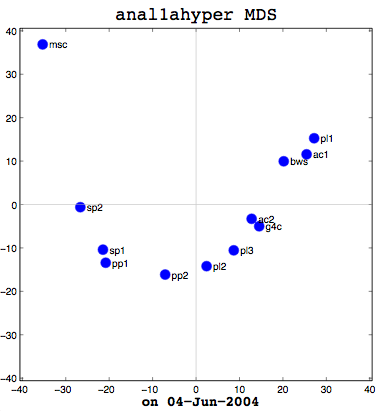
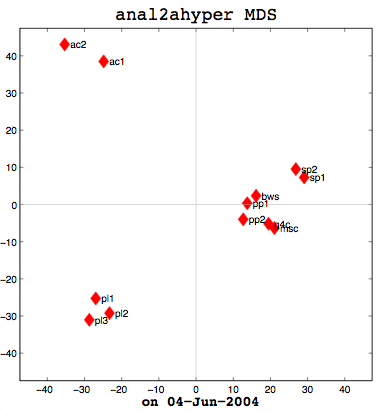
Anal1a, in terms of clumping, doesn't look very good, at least not anymore. That was not previously the case, but I had revised my algorithm to make it symmetrical as per the insructions of a computing statistician here at the University of Sussex. He claimed that the Procrustes Rotation needed symmetric data and my nonsymmetric data, where Doc1 vs Doc2 didn't have the same similarity as Doc2 vs Doc1, was not going to work. That change has, I believe, altered the efficacy of the algorithm and things are no longer clumped together as promisingly as they were previously. The clumps should be a two- or three-letter short code followed by a digit. Therefore, ac1 and ac2 belong together. Pl1, pl2, and pl3 belong together, and so on. The clumping is significantly better in the already symmetric cosine normalization algorithm (anal2a). The two speech processing documents are clumped together (sp1 and sp2), all of the Power PC and G4 documents are together (pp1, pp2, g4c), and the three Pine Lake tornado stories are clumped far away from everything else (which is all computer-related) and together on their own. Excellent clumping, in fact. So the hypernym hypothesis looks like, on these short documents, it is working well with cosine normalization.
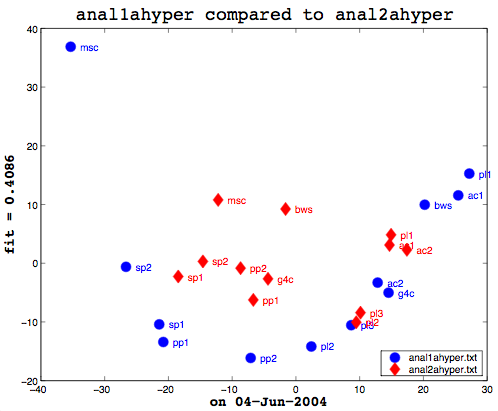
Here's the final bit of loveliness: comparing one MDS cluster diagram against another. MDS output is mapped to the vector space independently. That is, the same data will produce the same visualization or mapping, but different data is mapped to a different vector space, so you cannot just compare one MDS matrix to another directly. That is where Procrustes Rotation comes in. It applies a series of intelligent matrix transformations, trying to map the second vector matrix onto the source vector matrix. As a side benefit, essential in my case, it always provides a fitness measure to tell you how close the two were. on a scale of 0 to 1. So these two, as you can see (see above image), even after the transformations, were not that close together. As it happens, though, this is not particularly useful information to know. I am currently more interested in assessing how close the two algorithms are to human classifiers.
This recent success gave us plenty to discuss, particularly with respect to metric and non-metric data. The MDS community calls source data metric when the similarity or dissimilarity data is symmetric. That is, the value at row 2, column 1 is the same as the value at row 1, column 2. Classical multi-dimensional scaling (MDS) is designed to only work with metric data. SPSS includes the ALSCAL and PROXSCAL MDS algorithms which can work with non-metric data, but MATLAB's classical MDS does not because it treats things as Eucledean distances--another reason why I had to alter the Anal1a algorithm. The primary reason I now had metric data for everything, however, was because the computing statistician had told me I needed it for the Procrustes. Hawever, as we were examining my output, it occurred to me that Procrustes did not really care if the data was symmetric, so long as the dimensions of the data were the same (the same number of rows and columns). Which leads us to question whether the application of the method is statistically sensible or not. To that end, I need to track down a new computing statistician and perhaps a mathematician and discuss the process with them. My original computing statistician has retired.
Earlier I said that comparing one machine to another, to see how they fit is not useful information, but what would be interesting is to prepare a matrix of all the possible combinations of human judgements, cosine normalization, and weird formula:
                      cosine   wrd form.   human
cosine (anal2a)		x
weird formula (anal1a)           x
human                                        x
So that is my task for my next meeting (on the 16th of June). Before then, I need to figure out how to get MATLAB to take multiple tables as data. In SPSS, I could paste in several tables (representing all of the people's individual data, for example) and it would work with that. That is necessary in order to aggregate the peopel to do the comparison. Onward ho, then! Progress at last!
Dirty Data Done Dirt Cheap
I have to confess to feeling a bit stupid. I have been struggling with MATLAB for weeks now, trying to get it to read in my data files so I can automate my analyses. My data is in a tab-delimited file and looks something like:
	Doc1	Doc2	Doc3	Doc4
Doc1	100	76	18	91
Doc2	76	100	22	35
Doc3	18	22	100	65
Doc4	91	34	65	100
This is not too dissimilar from the labelled diagram, part of the MATLAB documentation on data importing. Except that, if you look at the table below it, which describes which functions to use, they don't have a function with a similar example to their labelled diagram. Early on I thought I should be able to use dlmread, which allows you specify rows/columns for starting points or a range. My idea was just to have a range which excluded the non-numeric troublesome labels. No matter what I did, though, I could not get it to work. It was frustrating, because I could paste the data into the Import Wizard and that could handle the data fine. I wrote people, I researched on the web, and I tried all sorts of things.
Eventually, I came full-circle back to dlmread and experimented by making a small data file with unrelated data in it. That worked fine. So I then copied half of one of my data tables into the test file and tried that. That also worked fine. I copied the whole data table into the test file and used dlmread on it. It worked fine! What was the difference between the two identical data files other than their filenames? When I uncovered the answer to that, I kicked myself. My data files were generated years ago and stored on my Mac OS 9-based laptop. My laptop and the data have since migrated to Apple's swoopy BSD-based UNIX goodness and that's the environment that MATLAB runs under. So... Have you guessed the problem? Yes, it was linefeeds! The data files had original Mac linefeeds and MATLAB wanted UNIX linefeeds. D'oh! It just goes to reaffirm that the things you don't see can really hurt you.
Once that was solved, work proceded rapidly apace as I was now able to finish automating the whole comparison process from start to finish.
function  [Anal1Raw, Anal2Raw, Anal1MDS, Anal2MDS, fit] =
      processEinCiteData(firstFile, secondFile, runName, labels)


% Read in the similarity matrices from the two data files
Anal1Raw = dlmread(firstFile, '\t', 1, 1);
Anal2Raw = dlmread(secondFile, '\t', 1, 1);

% Set up default document name labels if we didn't get any
if nargin < 4
	labels = {'g4c', 'pp1', 'pp2', 'msc', 'pl1', 'pl2', 'pl3', 'sp1', 'sp2', 'ac1', 'ac2', 'bws'};
    if nargin < 3
    runName = '';
    end
end

% Set up labels for the filenames
fileName1 = regexprep(firstFile, '\..*$', '');
fileName2 = regexprep(secondFile, '\..*$', '');

% Convert the similarity data to numbers below 1 for use in MDS
Anal1Raw = abs(100 - Anal1Raw)
Anal2Raw = abs(100 - Anal2Raw)

% Calculate the MDS and prepare a diagram showing the
% clusterings for the first document
[Anal1MDS, eigvals] = cmdscale(Anal1Raw);
figure(1);
plot(1:length(eigvals),eigvals,'bo-');
graph2d.constantline(0,'LineStyle',':','Color',[.7 .7 .7]);
axis([1,length(eigvals),min(eigvals),max(eigvals)*1.1]);
xlabel('Eigenvalue number');
ylabel('Eigenvalue');
plot(Anal1MDS(:,1),Anal1MDS(:,2),'bo', 'MarkerFaceColor', 'b', 'MarkerSize', 10);
axis(max(max(abs(Anal1MDS))) * [-1.1,1.1,-1.1,1.1]); axis('square');
text(Anal1MDS(:,1)+1.5,Anal1MDS(:,2),labels,'HorizontalAlignment','left');
hx = graph2d.constantline(0,'LineStyle','-','Color',[.7 .7 .7]);
hx = changedependvar(hx,'x');
hy = graph2d.constantline(0,'LineStyle','-','Color',[.7 .7 .7]);
hy = changedependvar(hy,'y');
title(['\fontname{lucida}\fontsize{18}' fileName1 ' MDS']);
xlabel(['\fontname{lucida}\fontsize{14}' runName ' on ' date], 'FontWeight', 'bold');

% Calculate the MDS and prepare a diagram showing the
% clusterings for the second document
[Anal2MDS, eigvals] = cmdscale(Anal2Raw);
figure(2);
plot(1:length(eigvals),eigvals,'rd-');
graph2d.constantline(0,'LineStyle',':','Color',[.7 .7 .7]);
axis([1,length(eigvals),min(eigvals),max(eigvals)*1.1]);
xlabel('Eigenvalue number');
ylabel('Eigenvalue');
plot(Anal2MDS(:,1),Anal2MDS(:,2),'rd', 'MarkerFaceColor', 'r', 'MarkerSize', 10);
axis(max(max(abs(Anal2MDS))) * [-1.1,1.1,-1.1,1.1]); axis('square');
text(Anal2MDS(:,1)+1.5,Anal2MDS(:,2),labels,'HorizontalAlignment','left');
hx = graph2d.constantline(0,'LineStyle','-','Color',[.7 .7 .7]);
hx = changedependvar(hx,'x');
hy = graph2d.constantline(0,'LineStyle','-','Color',[.7 .7 .7]);
hy = changedependvar(hy,'y');
title(['\fontname{lucida}\fontsize{18}' fileName2 ' MDS']);
xlabel(['\fontname{lucida}\fontsize{14}' runName ' on ' date], 'FontWeight', 'bold');

% Apply Procrustes to the two MDS results to map them
% into the same vector space and prepare a plot of the
% result
[fit, Z, transform] = procrustes(Anal1MDS, Anal2MDS);
figure(3);
plot(Anal1MDS(:,1), Anal1MDS(:,2), 'bo','MarkerFaceColor', 'b', 'MarkerSize', 10);
hold on
plot(Z(:,1), Z(:,2), 'rd', 'MarkerFaceColor', 'r', 'MarkerSize', 10);
hold off
text(Anal1MDS(:,1)+1.5,Anal1MDS(:,2), labels, 'Color', 'b');
text(Z(:,1)+1.5,Z(:,2),labels, 'Color', 'r');
xlabel(['\fontname{lucida}\fontsize{14}' runName ' on ' date], 'FontWeight', 'bold');
ylabel(['\fontname{lucida}\fontsize{14}' 'fit = ' num2str(fit, '%2.4f')], 'FontWeight', 'bold');
titleStr = ['\fontname{lucida}\fontsize{18}' fileName1 ...
        ' compared to ' fileName2];
title(titleStr, 'HorizontalAlignment', 'center', ...
    'VerticalAlignment', 'bottom');
legend({firstFile, secondFile}, 4);
At the end, I had a quantitative number, the degree of fit, between two diagrams after applying the Procrustes Rotation to them. Finally! On a whim, I fed in the same data table as both arguments to my comparison program. That is, I compared the same data file to itself. My hypothesis was that the resultant degree of fit should be either 0 or 1 (depending on which the fitness was measured). Much to my surprise, no matter which data file I used, the result was never 0 or 1. My previous Procrustes Analysis code was taken from some sample code in the MATLAB documentation and looked like: [D,Z] = procrustes(Anal1aMDS, Anal2aMDS(:,1:2)); That last bit in () is some kind of MATLAB scaling, which, being a novice to MATLAB, I didn't realize. So, in fact, my two diagrams weren't the same which is why I wasn't getting a 100% degree of fit. I do not want to say how long it took me to narrow that down. Once I did, though, it looked like I was basically set and I was able to quickly produce some comparisons between my "weird" half-baked metric and the cosine normalization one. One small step for EinKind.
This is a delayed entry from May 12th, 2004.
May 18, 2004
Anonymous Advertising in Poster Power
I was talking about my recent posters the other day with Teetee/Pi. He was asking me questions about how to interpret Figure 3 which shows the clustered output that results after feeding similarity data into the multidimensional scaling algorithm. I didn't have a copy of the page handy, so I pulled up the PDF version and happened to notice that the one-page version of my poster, destined for an ordinary sheet of paper, no longer had my name or my e-mail contact address on it. The only thing on it was a pointer to the three-page version of the poster on this web site.
Oops! Oops! Oops!
I was short on time when it was decided that a handout-sized version of information was needed, so I'd had my Sweetie build me the single page and the three-page versions based on the finished poster design. He got a little overzealous about saving space and, well, managed to axe the contact and affiliation information. It was missing off of the three-page version, too.
Alas, I didn't discover this until after the Open Day, so the damage has probably already been done. Nevertheless, I've prepared new versions of both documents with this information intact and added page numbers, where appropriate, to boot.
Live and learn! Don't be so concerned with the content that you fail to see the forest through the individual trees!
Downloadable Resources:
- A4 (regular page) handout sheet
- 3-page PDF version
May 14, 2004
X11 Xgfhfh!!xxxhgf74!!
I was trying to get X11 launching applications from the department's Solaris server again. As before, I couldn't immediately get it to work because of "magic cookie" authentication issues. I reviewed my previous notes which pointed to an article at MacWrite.com which might have helped before, but it was suddenly unavailable. The WayBack machine to the rescue. As soon as I had edited my /etc/ssh_config file to include the following information, I was good to go again:
Ciphers blowfish-cbc, aes128-cbc, 3des-cbc, blowfish-cbc, cast128-cbc, arcfour, aes192-cbc, aes256-cbc
Compression yes ForwardX11 yes
Protocol 2,1
RhostsAuthentication no
RSAAuthentication no
UseRsh no
Note: It may be necessary to take out the extra spaces between items in the Ciphers list.
That, of course, assumed I had already had an entry in my ~/.cshrc file to the effect of:
setenv DISPLAY :0.0
Then, I can simply use a variant of the following to, for example, launch dtterm:
ssh -X eingang@machine_name.com /usr/dt/bin/dtterm
MATLAB, unfortunately, doesn't seem to work at all. It used to generate all kinds of font errors looking for various Sun fonts, but it did launch. Now it launches with all the font errors (see sample below), shows the graphical about box and then we're in the command line environment instead of the GUI development environment.
Font specified in font.properties not found [ urw itc zapfdingbats medium r normal * %d * * p * sun fontspecific]
Font specified in font.properties not found [ urw itc zapfdingbats medium r normal * %d * * p * sun fontspecific]
Note: All the '-' characters appearing inbetween [] above have been changed to spaces to render better in HTML.
I've mailed the Mac technical support person to see if they have any ideas as to why it no longer works and how it might be possible to fix the font errors.
May 11, 2004
Love the License
By the end of April, I seemed to be stymied in my quest for an affordable copy of MATLAB that I could run on my local laptop. The university maintains a license pool for the base software plus toolkits. I do have access to run a copy from the license server when I'm on campus. It actually worked off of campus too, when I'd been told it shouldn't, but that turned out to be a mistake. When I reported it, the firewall was closed to the outside world for requests for the license server. That's where honesty gets you: no MATLAB accessibility from anywhere with an Internet connection.
I was hoping to snag one of the concurrent licenses for my permanent use and offered even to buy an additional one for that purpose as that would be cheaper. I was told that I couldn't have one and I should investigate the student version of the software. Unfortunately, the student version is only available to students in taught courses, not Ph.D. research students, so that wasn't any good. I mentioned to Thufir that I'd been turned down, reportedly by the head of software/hardware procurement within our department. Thufir promised to see what he could do. Then, last week, I received an e-mail last week from the lab manager, the person in charge of the procurement. He offered, if somebody would pay for it, to install an academic version of the software on my university-owned equipment for only £525 (~930 US/780 €). That was just for the base software and not also for the toolkit I need.
As I haven't met with Thufir since receiving the e-mail, I haven't discussed it with him to see if he's willing to cough up £525 (~930 US/780 €) plus £210 (~370 US/310 €) for the software for me. The lab manager stopped by my office today to see if somebody was going to pay for it and we entered into a discussion about the licensing arrangements. The academic license is only available for installation on university-owned equipment. I don't have any university-owned equipment. He doesn't want to be breaking the law by violating the terms of the licensing agreement which is fair enough. That does leave me in somewhat of a quandry: I don't qualify for the student edition; I'd be in violation of the license for an academic version; and I can't afford the £1625 (~2900 US/2400 €) commercial base software price plus an additional £600 (~1050 US/895 €) for the toolkit I need.
Why do I need my own copy? Can I live without my own copy? I can possibly do without my own copy as I can run it on campus, but I'm not on campus all the time. I do return to Canada for extended periods of time and we are investigating an option of moving back to Canada and having me commute out every quarter or so for a month as that would be cheaper than actually living here. Just last year I spent 6 months in Canada. Even if I am here, it's a problem if I just want to work from home. It would therefore be nice to have my own copy, but at what price?
I've told the lab manager that I'll get back to him. I'm meeting with Thufir on Friday. I also e-mailed MathWorks to ask about my situation and licensing arrangements for it. It does seem strange that their academic license is restricted by machine ownership rather than by reported use for the software. Their customer service auto-responder promises a response within 24 hours, but so far all I've received is the automatic response and a response from their database that my e-mail address has been updated in my profile. I have no idea what that's about. Maybe tomorrow will be better.
May 07, 2004
Poster Power
Today was the Open Day for the Human-Centred Technology group at the University of Sussex. IDEAs , my research lab, is part of the overall HCT group and a major participatant in the organization and presentation of the Open Day event, the first of which was held last year. I was unable to attend or to help out much with the organization as the event fell outside my scheduled university days. It was decided that we needed copious quantities of posters and every Ph.D. student was expected to make a poster about their project. Apparently this was timely as second- and third-year students were also expected to produce a poster for the department.
I spent oodles of time in April designing the look of the poster and then populating it with text. The finished version of the poster looked pretty good in its A1 size (~90cm by 60cm). Designing the poster in the absence of any input and with lots of nice-looking graphics to possibly incorporate led to a poster that was quite dense and text-heavy, although it had a fair bit of white space, too. A week before the event, the Lab decided that we should also have colour handouts to go along with every poster. Just shrinking down my poster from its large A1 size to A4 (regular paper size) resulted in a page that was legible (but not for readers with poor vision) with tiny graphics. The EinSweetie, who had more time, took the original poster and produced a handout version with not quite so much of the text and graphics on it. As a lot of the crucial detail had been cut, we also decided to make a short multi-page PDF version of the original poster text which could be downloaded. The URL was included on the handout sheet.
Doing the poster was very interesting, especially after my longish absence from working on my Ph.D., as it helped remind me of some of the major issues arising out of my research. A look at the big picture is often very helpful in clarifying your position and your journey. My examination or generation of the big picture led to me to realize that I was developing the fingerprints and the methodology for producing them, but then I wasn't using the notion of the fingerprint itself anywhere after that point -- something I'd completely overlooked, being caught up in the minutia of analysis for ages. I was so struck by this and other revelations that I had them make up a second laminated full-page version of my poster to hang in my office to remind me of the big picture. Life is so much improved when you can see where you're going.
Downloadable Resources:
- A4 (regular page) handout sheet
- 3-page PDF version
March 26, 2004
MATLAB & MDS
I need some help in using MATLAB and MDS, so I looked to Google to find resources. There seem to be more MDS resources than when I last looked quite some time ago. I found a useful page with links and pointers to MDS-related resources at http://www.granular.com/MDS/. From there, I obtained most of the resources for a pyschology course organized around MDS taught by one of the MDS's primary researchers Forrest Young. I downloaded all the notes in PDF format and stored them away to browse through. Young is the same researcher responsible for developing the ViSta software (Visual Statistics System), which looks a lot like that Canadian object-oriented, icon-based programming language. I remember looking at ViSta before, but I don't think it supported doing things like MDS and it hasn't been recently updated for anything other than Windows.
David L. Jones had a series of MATLAB pointers which included links to toolboxes for non-metric multidimensional scaling. The latter toolkit, developed by Mark Steyvers, doesn't come with any documentation and includes some DLLs, so I wonder if only works in Windows somehow? I couldn't find any other reference to it on the web.
I was waiting for the Mac support person to come install a new version of MATLAB for me. The demo installation and toolkits I installed last fall have long since expired. I'm also still waiting to hear back from the UNIX software support people in the department about acquiring one of the pool licenses for use with a copy of MatLab on my Macintosh off campus. Latish on in the day, I found the Mac support person and acquired a valid license file. It didn't work right off the bat. I had to edit the file and change the linefeeds from Macintosh ones to UNIX ones. After that, it worked great and it looks fantastic. So I should be able to start doing something with that soon. It also works from home, surprisingly enough, as long as I have an Internet connection, so that will be quite convenient. Hurrah! I am moving ahead.
March 16, 2004
Meeting with Supervisor
I had a short meeting with Thufir today to check on how much progress I have made at reintegrating myself back into the flow of university life. The number of things I managed to check-off from my last to-do list was woefully short, but still progress of a sort. For example, retroactive intermission was granted. I now have until September 30th, 2006 to finish my DPhil. That required very little work on my part or my supervisor's to put through. It was the fastest resolved intermission request ever. I also wrote up my 30 words and scrounged up a picture for the next HCT brochure. The only other completed task off my list was sending an e-mail to the Bulletin mentioning my Open University teaching award, about which I have yet to hear anything. As I only submitted that late last week, he figured it was still early days.
Despite my pitiful progress on the items on my list, I hadn't been completely idle. I was able to report that I had been investing time in helping coordinate and set-up the new FirstClass intranet to be used by the IDEAs Lab. I have also been providing some advice to Julie Coultas on creating a web-site specification for her EduServ project. These activities do not directly further my Ph.D. work, but Thufir pointed out that they serve to help relieve the intrinsic isolation of my position in the group, as I am not working on a project with others and my work is not very directly related to most of the Lab's projects. I must be careful, however, not to spend the majority of my time on Lab-related work.
On my list of things still to do is to sort out my MATLAB problems. Prior to leaving for Canada last October, I was in correspondence with Dr. Tom Browne, who is responsible for academic license management here at the University of Sussex. While the software can be run directly on campus from various UNIX boxes, copying and pasting data/diagrams between the UNIX machine and the Mac isn't particular convenient. Sussex maintains a pool of MATLAB licenses. Purchasing individual licenses and toolkits is very expensive, so I have been trying to acquire the use of a license for use on my Macintosh. I need to follow up and see what the status of this last was.
One of the things Thufir is concerned about is that I have been basically stuck at the same point of my Ph.D. for several years now. Of course, that has not been helped by my lengthy absences due to work and my poor health over the past few years. It also has not been helped by the fact that the analysis I need to do is quite tricky and not understood by many people. Thufir admitted that the statistics was beyond him. Imagine a supervisor not knowing everything, but he was happy to admit he's not the end-all, be-all for everything. He tried forwarding me to various people and I spent ages asking people for advice and help all over the Internet and locally before I chanced across something on my own. The other factor that has been impeding the analysis is that statistics is not my strong point. I do not enjoy doing this analysis, yet it is hanging over my head like the sword of Damocles. He worries the analysis tarpit is making my Ph.D. a chore and leading to anxiety and a constant circling without any substantial progress. He is looking for ways to help me break the "logjam." He suggested two things. One thing was to look for something "fun" that I could start work on now, which might help rekindle my enthusiasm for my project. Another related idea is to see if there is something I can do which does not hinge upon the results of the analysis, perhaps, for example, some of the writing. I promised to look at that as I continue my work on updating my timeline.
Finally, we discussed my general health and wellbeing. I confessed to being tired, after a hard week the last time he saw me of preparing for a big client demo and then following it up the week after with energy-intensive marking. He wondered if I could afford to not do the work at the Open University. The financials do not allow that at the present time. Almost half of what my company paid me (pre-tax!) went out as rent here in England. Without the OU income, I would have been in the hole. Nevertheless, I did discuss with him my idea of working more at the OU, maybe up to three days a week and none for my own company. I would probably make more money, be less stressed, and have more time to spend on my Ph.D. Doing so, particularly without planning and warning, would place my own company in a precarious position, so I will need to muddle along as best as possible for the moment.
Next meeting is April 2nd at 16:30.
Task list:
- Resurrect and review Ph.D. plan.
- Sort out MATLAB issues
- Work on CSR version of my paper so that I can submit it for publication and send it off to my external advisor
March 12, 2004
Bulletin Bravada
I spent part of today working on a 100-word statement that the Open University wants to put on their web site closer to the time of the award presentation ceremony. I find it ironic that, after writing two pages about myself in order to apply for the award, I have to write another 100. I find it even more ironic that I also had to suggest a sentence to put on the certificate. For the certificate, Stephen and I eventually settled on "for outstanding dedication and excellence in on-line teaching."
That still left the hundred words to be written. I reviewed my original award application material and put together the following:
Michelle focuses on Internet technology courses delivered primarily on-line. In TT280/TT281 (Design, Development, and Management/Client-Side Scripting), she provides extensive guidance through the development of supplementary course materials, in-depth FAQs, and a strong breadth of knowledge. She is a passionate communicator about technology, believing technology is sometimes only as difficult as people make it. Therefore, demonstrating a belief that students can achieve is a key to student success. In computing and technology, where women are scarce, she is a visible role model that women can succeed well in these traditionally male-dominated fields even if they have tangible weaknesses to overcome.
Once I had that out of the way, I decided I might as well go whole hog and e-mail the The Bulletin as suggested by Thufir. Not being familiar with the publication and what information they might require, I probably went overboard.
Greetings and Felicitations.
I'm a part-time D.Phil. student in the IDEAs Lab in Informatics. My supervisor suggested that I contact The Bulletin as I've just won (or will shortly be awarded) an Associate Lecturer Teaching Award for excellence in teaching at the Open University, one of two awards to be given out at the national faculty level in my faculty.
In order to win the award, I was competing against all associate lecturers in the Faculty of Technology at the Open University across the United Kingdom. While I'm not sure how many ALs that is in total, I do know that my own region has about 50-60 ALs alone in Technology. The award will be presented on the 20th of April in a ceremony at Milton Keynes and comes with a £1000 to be used for personal/professional development.
Here's a personal statement I wrote for the OU about myself with respect to the things I've done to win this award:
Michelle focuses on Internet technology courses delivered primarily on-line. In TT280/TT281 (Design, Development, and Management/Client-Side Scripting), she provides extensive guidance through the development of supplementary course materials, in-depth FAQs, and a strong breadth of knowledge. She is a passionate communicator about technology, believing technology is sometimes only as difficult as people make it. Therefore, demonstrating a belief that students can achieve is a key to student success. In computing and technology, where women are scarce, she is a visible role model that women can succeed well in these traditionally male-dominated fields even if they have tangible weaknesses to overcome.
I started at the Open University in May of 2000. During my tenure, I've taught:
M150 Feb 2004
T171 Feb 2003, Feb 2002, Feb 2001, May 2000
TT280 Oct 2002, May 2002
TT281 Oct 2003, May 2003
TU170 Feb 2002
Course Team Work TT280/TT281 Feb 2003
M150 is Data, Computing and Information
T171 is You, Your Computer, and the Net
TU170 is Learning Online: Computing with Confidence
TT280 is Web Basics: Design, Development & Management
TT281 is The Client Side of Application of Development
The award is for my efforts over the span of my OU career so far and not just the last year.
I'm not sure what else I can tell you that might be helpful or interesting. If you have any questions, please do ask. E-mail is the best way to contact me. I can provide a photo if you need one.
OK. I did get a bit unfocused and go overboard, but I find it so difficult to write positive things about myself. Whatever hapened to the adage "the Rabbi who praises himself has a congregation of one"?
March 08, 2004
Brochure Bravada
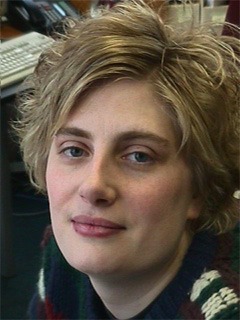
As part of my tasks, I need to acquire a suitable image of myself plus put 30 words of copy together for the annual Human-Centred Technologies brochure. 30 words isn't very much, and I wasn't quite sure whether those should be about me or about my project or about both. In the meantime, I set the EinSweetie to sorting out possible pictures. I dislike having my picture taken, so our collection isn't vast and many of the pictures were taken outside where I'm wearing my sunglasses.
Here's the picture I chose for myself. Even though it's several years old, it was the best we could find on short notice and spending several hours trawling through iPhoto.
That still left the 30 words. I settled on the following 31 words:
Michelle concentrates on Internet information retrieval: improving the indexing and return of search engine results using semantic relations. She is an award-winning Open University lecturer, incorporating IT into distance education.
Not quite 30 words, but close enough.
March 02, 2004
Of iPods, Infrastructure, and Intermission
Today was my first day back at the University after an extended absence. I filled it in by doing mostly administrative things. Let there be iPods, bibliography software, and printing everywhere!
Planning:
I started off the day by trying to set myself up a new research calendar of days at the University. The calendar left on the door only went until October and, of course, none of those dates were ever used. I consulted with Stephen and arranged to have 5-7 days a calendar month for my research. In most months, 5 of the days are in a row with the other days being made up of Fridays about two weeks before and after the week-long period. I tried to take into account that we might be taking a week off in May to go walking in Scotland. The other days chosen are mostly Fridays because that's the day we have our IDEAs Lab weekly meetings. One of the things I complained about at our last "away day" was feeling isolated. If I attend meetings, then I won't be so isolated. The proposed calendar can been using iCal at webcal://ical.mac.com/eingang/Ph.D..ics or on the web at http://ical.mac.com/eingang/Ph.D..
I'll need to take the proposed dates and map them onto my research plan timeline. Oh boy, another battle with Fast Track Schedule. Is it so much to ask for that a piece of software allow you to edit some things and then have things dependent on that automatically update? Apparently it is, because it's a pain in the butt to do, but there isn't a lot of choice of project scheduling software available for the Mac. If somebody knows of something better, please do let me know.
Infrastructure Changes:
After 6 months away, the wireless roaming network is finally live across the campus, but you can't print from it. Apparently, it was mostly designed with students in mind and students (undergraduates) don't have access to free printing. I'm hoping they come up with a cunning plan, because it's kind of weird to not be able to see any of the printers on the network and I can't, apparently, print to them by IP (although I don't know why).
While my office was still intact, I needed only to shove some stuff aside, the printers around the building have changed. I had to do all the "Adding" of printers, where I discovered that Mac OS X's (10.3.2) discovery of printers via AppleTalk is somewhat slow. It seems to take a bit of time to "sync" up when you first connect. In theory, I should now be able to print seamlessly, while plugged in via ethernet, to either printers on the COGS research network or on the teaching network. The teaching network printer is a lot closer, being only a few doors down. The rest of the printers are on different floors.
I had Christian give me a copy of EndNote 7 for the Macintosh. I had requested a license from the lab when they were ordering licenses for themselves. I've previously always bought and paid for my own academic license. Version 5 of EndNote, which only runs under Classic, worked with text files, other word processors, and FrameMaker MIF files. As I typeset all of my papers in FrameMaker, this was very convenient. Version 6 dropped that and only supported typing papers into Microsoft Word. At least this version allows you to use something other than Microsoft Word, but it's still RTF, which isn't as convenient for me. If I want to make changes, I have to update the FrameMaker file, produce an RTF document, parse that to insert the references, and then print the RTF file. We'll see how that works. When you change formats, some formatting always gets lost, so I am not completely hopeful.
Intermission:
I picked up a new photocopier card from the postgraduate secretary. The regular school secretaries wanted me to have a research grant to apply the charge to, but I was pretty sure I was entitled to a quota of copying per year as a research student, as indeed I am. I also asked her about the whole intermission process as my supervisor wants me to intermit. Apparently, I can only intermit entire terms, so I need to intermit for the fall and spring terms. I guess that makes any time I spent in March bonus time, assuming I'm granted intermission. She says she doesn't know of any limits for postgraduates on intermitting, which is good, because I'm apparently going for some kind of record. I also don't need to write another letter. If my supervisor e-mails her, she'll prepare the necessary paperwork and all will likely be well. I e-mailed my supervisor and suggested he do so to get the ball rolling. I'll check back on that in a few weeks.
FirstClass:
The IDEAs Lab has just teamed up with the new Creative Systems group to purchase a FirstClass server and some client licenses. The intention is to create a shared space for the IDEAs group people to be able to collaborate/discuss papers, have shared resource calendars, and update the IDEAs web site automatically with content from FirstClass. I was just discussing this with my supervisor at today's meeting. As I was searching for some BluTak in our resources room, a contingent of people came excitedly down the hallway looking for me. They knew that I was very familiar with a href="http://www.centrinity.com/" title="FirstClass from Centrinity">FirstClass from my work at the Open University and that I was also a technical web person. They want me to liaise with the FirstClass configuration person, so I've added that to my list of tasks to undertake in the next week.
iPod Study:
Michael Bull is doing a study on the use of iPods. Siufai saw a Wired article about Michael Bull and how he's looking for female inverviewees. Imagine my surprise to discover that he's at the University of Sussex too. Actually, I'd read an article in the New York Times (online) edition a week or so ago entitled The World at Ear's Length, all about how people completely shut out the world by using iPods in New York. That article also mentioned Michael Bull. Anyway, I had contacted him about being interviewed, being an iPod junkie, and had arranged to meet him this morning. I arrived at the appointed time, waited twenty minutes, and there was no sign of him. I left a note and followed up with an e-mail, but I haven't heard back from him.
So, there's lot to do, but time has run out for today. I need to wrap up, file things away, and head for home until the next day.
Meeting with Supervisor
I met with my supervisor briefly this afternoon. Given that I'd just been gone for another 6-month period, his first serious question was whether I wished to continue with my Ph.D. or whether I needed an "easy way out." I assured him that I still wanted to finish my Ph.D. and that I didn't need an "easy way out." That question once again settled, we then proceeded on to the practicalities of actually doing a Ph.D. With my recent long absence, he was all in favour of me applying to extend my last batch of intermission to cover the fall and spring terms. He suggested I write another letter to Phil Husbands, asking for intermission due to work.
As always, the issue of my health and medication was included. I assured him that my health had been good of late. He thought I looked a lot healthier, too. My medication usage, I had to relate, was not completely perfect, but it was a lot better. I explained how I was trying to balance my life a lot better, taking weekends off and suchlike. I have been aided in this quest by a dynamic to-do-list manager called LifeBalance. I showed him my desired versus actual pie chart and today's to do list and explained how it was time- and place-sensitive. By trying to do things only in the time slots allocated for them and relaxing outside of work/research hours, my health has improved and I'm not quite as stressed.
Nevertheless, I still had to confess that I basically had not accomplished anything since our previous meeting on the 23rd of September and that our librarian was hounding me to submit my revised paper as I promised her I was going to publish it as a Computer Science Report last year. She now has a gap in her numbering and wants me to cough up the goods. My supervisor thought that would be a good place to start in getting my mind back into my research. Revision of that paper and publication of it is also what I have been waiting on before seeking assistance from an external advisor, so it all ties together nicely.
He also thought I should make sure that I am represented in the upcoming annual HCT publication, with a picture and a description of my project. As that was already on my list of things to do, that is not a big deal. I believe I can even recycle previous material. I showed him my to-do list and my latest calendar for working on my Ph.D., which reminded him that I should unearth my research plan and update it for past progress and new timelines. I am not looking forward to that, but it is good to have a timeline. My new proposed timetable gives me between 5 to 7 research days at the University a month.
I mentioned, almost in passing, that I will be winning a national award for excellence in teaching from the Open University. He was extremely pleased and suggested that I drop a note to the editors of the Bulletin, a weekly newsletter here at the University, as that's the kind of tidbit they'd likely want to publish. That also led into a discussion of what I am doing at the Open University and my usage of FirstClass there. Our Lab is getting a FirstClass conferencing system for sharing resources and updating web pages. I wasn't sure how well it would work for updating web pages automatically, as I have not seen FirstClass really used for that, beyond shared calendars, but I think it's a neat experiment.
Finally, I told him that I'd actually put together a research blog which was currently very short on content and unindexed by Google, but it was a good place to start my efforts in building myself a community. It's another positive step forward.
At the end of the meeting, we closed, as usual, by selecting a new meeting date. Next meeting is a half hour squeezed inbetween other appointments on Tuesday, the 16th of March, at 16:15.
Task List:
- Send another letter to postgraduate dean about extending intermission from October to end of February.
- Send HCT Info to Rose's secretary for inclusion in annual publication.
- Resurrect and review timelines for my research plan.
- Send note to A.F. of the bulletin about winning teaching award at the Open University.
- Review the paper for submission to the library.
- Send e-mail to F.S. saying I'm alive and include revised version of paper.
- Review MATLAB application acquisition status.
January 27, 2004
Blogging My Life the CSS Way Away
As part of goal to improve my networking and reach out to the community, I had a task to start a research-oriented blog. I set up the software all the way back in September, before I suddenly had to return to Canada on a business trip, but since I haven't yet returned, I hadn't really invested much time in my Ph.D. in general or in that task. I remedied that somewhat today by spending the bulk of the day tweaking the look and feel of the two blogs I have and then adding some back-dated content to this one.
One of the things I wanted for the two blogs was a unique but similar look, so the two layouts are basically identally. Even though the layouts look very simple, it took me hours and hours back in September to research the CSS required to lay the pages out in three columns plus a spanning header/footer without using any tables. The tricky part wasn't so much the lack of tables but in getting CSS which would work consistently across the different "standards-compliant" browsers and did not employ absolute positioning in order to work. Judicious use of the float properties in CSS and div elements seem to have it under control, at least for browsers I use.
The floating three-column layout with spanning headers/footers:
#leftcol, #middle, #rightcol {
background-color: transparent;
float: left;
}
#leftcol {
width: 17%;
min-width: 8em;
padding-left: 5px;
padding-right: 5px;
}
#middle {
width: 58%;
padding-left: 5px;
padding-right: 5px;
border-left:1px dotted #999;
border-right:1px dotted #999;
background:#333;
}
#rightcol {
width: 17%;
min-width: 8em;
padding-left: 5px;
padding-right: 5px;
}
#header, #footer {
width: 100%;
padding: 0em;
background:#000;
color:#FFF;
}
#footer {
clear: both;
}
Once that was figured out, organizing the content into logical blocks was easy enough and away we went. The last major CSS tweaking I did back then was to add automatic tagging of internal versus external links. External links have solid underlines and, depending on your browser, an animated spinning globe to the left of them inline with the link. They also turn orange when you run your mouse over them (hover). Internal links don't have any inline graphics, turn green when you hover over them, and use a dashed underline. The CSS wizardry that does this is part of the CSS3 Selector Recommendation from the W3C. I followed Stuart Langridge's write-up at http://www.kryogenix.org/days/external.
Today's efforts were focused on colour schemes. Ein2 has a very pleasing colour scheme of blues and greens, which I very much like. For the research blog here, I wanted something a little more serious. The original page started off mostly in greys with a little bit of light blue thrown in. It was very monochromatic and serious, but not very inspiring. Fellow Brainstormer Jim Lai dug out his colour theory books and we set to work with a will and ended up with an analogous colour scheme to Ein2 but a little more formal in presentation. While I don't like it as much as the other, it will do for the moment.
I've also added some text about my recent talks and writings. I'm hoping to start using Tinderbox to manage production of information about papers or talks I've developed and papers/books I'm reading which can be automatically updated and then included in this blog. That's a task, however, that will have to wait for another day as will a description of Tinderbox and trying to validate included stylesheets in external stylesheets that use CSS3.
September 23, 2003
Balancing Intermission & Other Tasks
Intermission:
Yesterday both Livingstone and I had mail from Linda saying that my application for intermission had been sent off to the powers that be at the end of August. By then we already knew as a letter had arrived that day. Intermission has been granted. My maximum period of registration is now January 9th, 2006. It sounds like a long time away, but it's not really. I basically have two years to get myself out of the door, unless I can get an extension.
CSRP Technical Reports:
I had mail from Celia today. I've been assigned my own CSRP number of 565. I need to pick up a form to attach to the hardcopy of my paper. Before I do that, I need to some tweaking and Livingstone would like to review it before it goes. Once that's all done, I can send it off to Frank Shipman at Texas A&M who has agreed to provide some external support for me thanks to the evangelizing of Jim Rosenberg.
Life Balance:
I spent part of the afternoon purchasing and configuring LifeBalance for my Macintosh. The thery is that it helps you to more easily balance the different aspects in your life. It does this in several ways. One of the ways is by displaying a visual pie graph of how you spent your time versus how you would like to be spending it. It also allows you to define places, hours, and projects and I believe you can then use it in a mode which encourages you to work on the appropriate thing at the appropriate time and optimize your time usage.
Wireless Working:
Met with Kelvin Pope of Computing Services today to see why we couldn't get my internal AirPort card on the network. It turned out that it was a MAC address issue. I had somehow twice obtained the wrong MAC address for my laptop, which is why it wasn't getting an IP address. This is now all solved.
Meeting with Supervisor
I met with my supervisor briefly at lunch today. We quickly reviewed my intermission status and I reported on my previous week's efforts. I, of course, had to relate my "D'oh" moment about the X applications running on my Mac and then discussed running it off of rsunx versus locally. He wants to be kept informed on my progress in obtaining a license. There's a possibility that the department might be able to buy/subsidize a license and I should let him know if money needs to change hands.
The MATLAB discussion led quite nicely into the progress. I was able to show him a graph and explain what I had been doing and my current problems. He's going to look for info on MATLAB courses at the university and/or tutorials so I can get up to speed faster. He also reminded me that David Young is a MATLAB resource I might be able to tap.
He was quite pleased about my progress and thought I'd managed to get quite a bit done, even if I hadn't yet completely solved my analysis problem. At least I was getting somewhere.
Things To Do:
Clean up report and give to Ben before publishing as CSRP
Continue work on MATLAB
Read my Hypertext '03 papers
Research what I was waiting for David and Ian to provide
Continue on with MATLAB licensing issues