November 06, 2009
WoW Survey Deisgn: Putting the Horse Before the Cart?
I've been thinking about the design of the study I want to do on motivation in World of Warcraft. My immediate approach, similar to introductory programming students, was to jump right into the meat of it and start writing survey questions instead of planning. In order to get the data you need in the study, you need to know what questions you want answered. You need to plan. Without knowing that, how can you write survey questions to elicit those answers? So what is it I want to know?
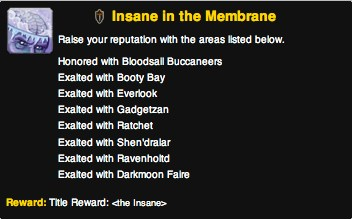
I want to say something about the kinds of motivations people have for playing World of Warcraft. Specifically, I want to enumerate factors that motivate players to persist in the game even when it involves tasks that are repetitive, boring, or seemingly impossibly long. For example, there's an achievement in World of Warcraft called "Insane in the Membrane" that gives the completer a reward of an in-game title of "The Insane." This achievement requires you to raise your reputation points with different game factions to exalted, the highest level. Generally, you need about 21,000 points to reach exalted. Points are gained by completing quests, collecting and turning in items, or sometimes killing certain types of things. If you only had to gain exalted reputation with one or two factions, this would not be difficult. However, you need to do this with eight different factions, most of which are not factions you would be accruing large amounts of reputation with during the normal course of play. To increase the difficulty, several of the factions involved have rival factions. With those factions, as you gain reputation with one, you lose reputation points with the rival faction, making the process of completing this achievement complex in addition to time-consuming. The WoWWiki (2009) page describes some strategies for completing this achievement and the complexities of the faction-rival relationships.
Most tasks players undertake are not going to be as complex, time-consuming, or mind-numbing to complete as the aptly-named "Insane in the Membrane". There are, however, many smaller day-to-day activities necessary for successful raiding or to get some particular piece of gear, such as doing daily quests to earn gold, or harvesting materials for potions or enchantments, or completing instance and after instance to get badge rewards or reputation rewards. I'm making it sound like getting achievements or gear is the be-all, end-all, but I think the situation is more complex than that. It's that hypothesis I want to verify.
Other things I would like to be able to comment on include the relationships between gender and motivation, or motivation and age, or possibly even motivation and nationality. I do not necessarily believe there will be a relationship between motivation and nationality necessarily, but how can you definitively say if you do not look for the correlation? That gives me the following questions I want answered:
- What motivates people to play World of Warcraft?
- What motivates people to persist in very boring or difficult tasks?
- Is there a relationship between gender and stated motivations? If so, what is it?
- Is there a relationship between age and stated motivations? If so, what is it?
- Is there a relationship between nationality and stated motivations? If so, what is it?
- Is there a relationship between character roles and classes and motivation?
With those six questions in mind and the original study idea of determining motivation via analysis of free-form essays about motivation, I can now go ahead and develop the specific survey questions that will help elicit data to answer those questions. Going back to considering my approach-whether I should start with planning versus start with survey question-it was not as clearcut as I expected. By starting with some potential survey questions and then thinking about the answers I would get from them, I gained a better idea about what answers I wanted, a kind of iterative development process. Sometimes putting the horse first helps you know where and how to put the cart!
References:
WoWWiki. (2009) Insane in the Membrane, [online] WoWWiki. Available from http://www.wowwiki.com/Insane_in_The_Membrane (Accessed November 6, 2009).
August 04, 2009
World of Warcraft and Me: A True Confession
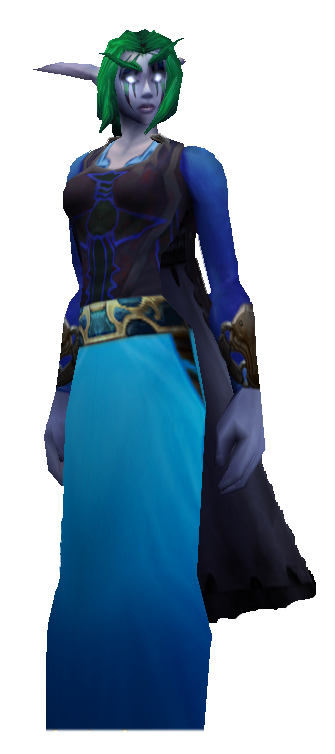 As part of a course under development at The Open University, I was approached as a known World of Warcraft player and asked to write a short paragraph or two on why I play World of Warcraft. I freely admit to failing to only write a short paragraph or two, but that's probably because I'm passionate about World of Warcraft and my activities in it, especially given the prominence it plays in my life in so many areas. Read on to find out why I play World of Warcraft.
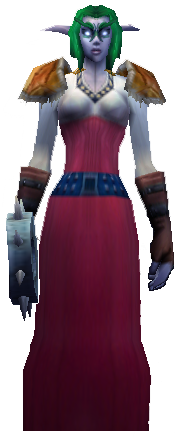
Elsheindra (me)
Hello, my name is Michelle Hoyle. By day, I'm a respectable Open University course author, associate lecturer, and course presentation chair. At night, I assume my secret identity: Elsheindra, night elf guild mistress of The One on a European World of Warcraft (WoW) server. You're probably thinking that massively multiple online role playing games (MMORPGs), like WoW, are just for kids. In fact, according to research (Lenhart et al, 2008; Yee, 2008), only about 20% of WoW players are between the ages of 12 to 19. That means some 80% of players are solid, upstanding citizens of the world. They could be your tutors. They could be your next door neighbours. They could be that person you see walking down the street or buying beef at the butcher's. World of Warcraft, as of May 2009, was holding steady at 11.5 million active subscribers (Blandeburgo, 2009; Chuang, 2009). That's over 60% of the online gaming market. It's the most successful personal computer game ever to be released.
What is it that compels these people to spend around 20 to 24 hours a week (Hagel and Brown, 2009; Yee, 2005) in a virtual world? Is it the killing? Is it the girls? Is it the beautiful scenery? Is it the fantastic fashions? People's motivations vary, so I can't give you a universal motivation, but I can reveal something about why I play. I play for three reasons: because I'm a community builder, because I'm a teacher, and because I love to help people. They're all a bit related. I have spent my life bringing people together and helping them form cohesive, long-lasting communities. It started back in the 1980s with electronic bulletin boards and continues today with World of Warcraft. That's why I run a guild and co-lead an alliance of guilds.
A guild in World of Warcraft is a collection of people who share things in common. The game gives them some tools for sharing, like a shared chat area, calendar, and a bank in which to store money or items for common use. They usually share a philosophy. My guild, for example, is a social guild with a philosophy of doing random acts of kindness. An allied guild is composed of people together for friendship or fun. When my guild members aren't out being kind to the other 4000 people on the server, they have each other to group with on small tasks, called quests, like curing sick deer or ridding an area of nasty rabid bears. A guild is also a pool of people with which to go on longer adventures in groups of five for rewards like armour and gold in mazelike environments where there are obstacles to overcome and difficult, large monsters to kill—so-called dungeons. The alliance of guilds I help lead allows smaller social-minded guilds like mine to be able to participate in even larger, more complex adventures that require 10, 25, or 40 people at a time. It is very rewarding to be in a position to enable people to have fun, but at the same time promote learning of important social interaction and problem solving skills.
Where does the learning come from? The learning is, in fact, everywhere in the game. Those 5-person dungeon groups or the larger 25-person groups require leaders to decide on strategy and direct the other people with varied motivations. Some people go to these dungeons only to get better gear. That's their motivation. Other people go for the feeling of accomplishment in participating in something difficult. When people are there for gear, there can be clashes over who should get it, which requires good interpersonal relationship skills and diplomacy on the part of the group leader. In our guild alliance, we've had leaders good at strategy and telling people what to do but with terrible interpersonal skills. That made their adventures not very fun, so people were reluctant to participate. Likewise, running a successful guild over a long period of time requires all manner of leadership and diplomacy skills. WoW is a safe, low-risk environment in which to learn these things and they can transfer into real-world rewards (Brown and Thomas, 2006).
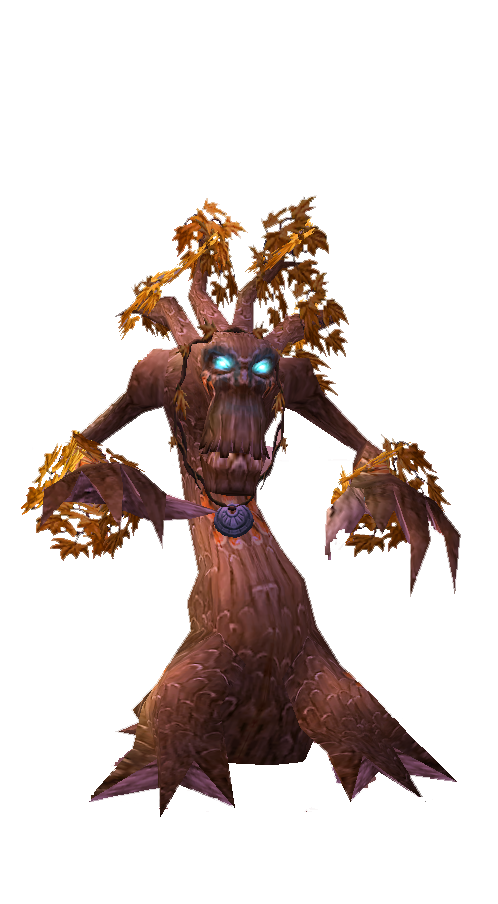
Elsheindra as a healing tree
In order to contribute to a team effectively, people need to learn to play their characters well. Each character has specific abilities. Elsheindra, my character, is a druid healer. She cures people of diseases and poisons and heal their bodies of damage they have taken while fighting. I've specialized in being a healer for over four years. I've become really, really good at healing by dint of lots of practice and much analysis of how things work. I have pride in my abilities and I love being able to help people in the game in a non-violent fashion, because I was not much interested in hacking and slashing at things. Other people are extremely interested in effectively killing things and devote hours outside of the game to reading about their character's role and how to improve on it, often in very tiny increments. I'm very willing to share my knowledge and experience with other people and often other very good players are too.
I've told you a lot about what kinds of things I do in World of Warcraft and my initial motivations. What I haven't told you are the things I've gained: love, acceptance, friendship, and a Ph.D. project, in order of importance. I'm currently researching what elements in games like WoW contribute to motivation and whether or not that can be transferred effectively into distance learning (Hoyle, 2009a; 2009b). Both feature activities that are a lot of work and, let's face it, aren't fun. In World of Warcraft, though, people persist with these difficult, not-fun tasks. I know I've persisted in some things because of the friends I've made. Those friendships have even transcended the virtual world, with people helping me move from apartment to apartment multiple times, even though they live in a different city.
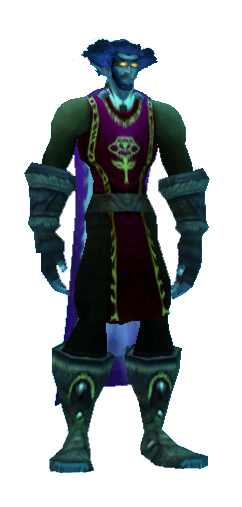
Basil, my partner
The alliance of guilds I co-run just had a real-life adventure at Bletchley Park and a BBQ at my house afterwards, one of several such successful large-scale events over the years. It's also not uncommon for some of my guild mates to just come and visit from other parts of the UK or from other countries. One of my guild mates even came along from Denmark to Canada for the summer. Are we just strange misfits? That's a common perception of gamers. I don't fit in lots of places but in WoW there's a place for me, as there is for them, and it's not just because "on the Internet nobody knows you're a dog". Finally, "Basil", my real-life partner, is someone I met in WoW because he was helping me co-lead the alliance of guilds. We've been together for over two and a half years. We still play WoW together on a regular basis, although not 20 some hours a week. There's nothing like a romantic date night with your beloved and 23 other friends.
WoW is like a fairy tale: magic, dragons, true love, fashion, elves, and orcs; but it's also what I've made of it: a place to be myself and to do the things I love to do.
References
Blandeburgo, B. (2009) ‘Activision "WoWs," But Where's Wireless?’, The Game Trade Journal, blog entry posted March 4, 2009. Available from: http://www.gametradejournal.com/2009/03/activision-wows-but-wheres-wireless.html (Accessed August 4, 2009).
Brown, J.S. & Thomas, D. (2006) ‘You Play World of Warcraft? You're Hired!’ Wired, 14.04 [Online] Available from: http://www.wired.com/wired/archive/14.04/learn.html (Accessed August 4, 2009).
Chuang, T. (2009) ‘WoW Stuck at 11.5 Million Subscribers; Blizz Focused on StarCraft, Diablo’, OCRegister Blizzard Blog, blog entry posted May 7, 2009. Available from: http://gaming.freedomblogging.com/2009/05/07/wow-stuck-at-115-million-subscribers-blizz-focused-on-starcraft-diablo/2201/ (Accessed August 4, 2009).
Hagel, J. & Brown, J.S. (2009) ‘How World of Warcraft Promotes Innovation’ Business Week Online, January 14 [Online] Available from: http://www.businessweek.com/innovate/content/jan2009/id20090114_362962.htm (Accessed August 4, 2009).
Hoyle, M.A. (2009a) ‘Levelling Lifelong Learning: Annual Progress Review’, E1n1verse, blog entry posted June 7, 2009. Available from: http://einiverse.eingang.org/archives/2009/06/levelling_lifel.php (Accessed August 4, 2009).
Hoyle, M. (2009b) WoW! Roberts & Susans Game Learning, [online] Slide presentation. Available from: http://www.slideshare.net/Eingang/wow-roberts-and-susans-game-learning-a-look-at-world-of-warcraft-higher-education-learning-and-motivation (Accessed August 4, 2009).
Lenhart, A. et al. (2008) Teens, Video Games, and Civics, Pew Internet & American Life Project. Available from: http://www.pewinternet.org/Reports/2008/Teens-Video-Games-and-Civics.aspx (Accessed August 4, 2009).
Yee, N. (2005) ‘MMORPG Hours vs. TV Hours’, The Daedalus Project, blog entry posted January 11, 2005. Available from: http://www.nickyee.com/daedalus/archives/000891.php (Accessed August 4, 2009).
Yee, N. (2008) The Daedulus Project, [online]. Available from: http://www.nickyee.com/daedalus/docs/shared-data.php (Accessed August 4, 2009).
June 07, 2009
Levelling Lifelong Learning: Annual Progress Review
 I have my annual Ph.D. review meeting tomorrow afternoon. As usual, I'm more than a bit nervous, especially as I made the big step this academic year of completely dropping my former Ph.D. work and starting a brand new topic that intersects the boundaries of my three main interests: communities, learning and teaching, and Internet-enabled technologies. As part of the review process, we're asked to produce a 4-page report that explains what we've done since the last report. In your first year, this report ought to focus on your thesis proposal, although many students won't yet have one. I do have some ideas about what I want to do and how I am going to go about it. I've made an online version so that it will be indexed and easily findable by others interested in World of Warcraft and e-learning.
The 30-second summary: Examine how metaphors and game design of World of Warcraft motivate people to learn and to work, with an eye to transferring motivation, social knowledge building, and persistence to online higher education practices, like community building for lifelong learning.
Click the "More" link below to continue reading the online version of the proposal and progress report. A downloadable PDF version is also available.
What’s Gone Before
“Those who cannot learn from the past are condemned to repeat it.” - George Santayana, 1905 (2005)
I started my part-time D.Phil in 1996 with Ben du Boulay as my supervisor working on something that was a combination of information retrieval and natural language processing. For various reasons—health, job, personal reasons, etc—I intermitted a lot. As my last intermission period was expiring, I put a great deal of thought into whether I wanted to continue or not. I was loathe to completely give up everything, so I decided to continue doing a Ph.D. but unite my three lifelong interests into something more related to what I actually do: educational technology. I therefore started a new D.Phil with Dr. Judith Good in October of 2009 within my original period of registration.
Research Questions
What do I hope to discover?
There are three primary initial research questions:
- How is the “Robert and Susan” metaphor applicable to World of Warcraft and what does that gain us in understanding how to successfully encourage lifelong learning and build communities of learning?
- How does the social structure in-game and out of game resemble a community of practice? How much of a role does social knowing play in the development of expertise and the dissemination of learning? What features would it be useful to adopt when designing learning communities?
- What encourages game players to persist in learning and working, although many tasks are boring and repetitive, and to continue improving long past their current goal? How does this relate to Hagel and Brown’s (2009) “lessons”?
Roberts and Susans
Hello, my name is Susan. I am bright and highly motivated. I love to learn and to think about things. Robert is taking endless lecture notes until he gets his degree. Robert is very different than me.
The nature of universities and the characteristics of their students are changing. Students no longer arrive on the university’s doorstep intrinsically motivated to learn regardless of the teaching method employed. Tim Clydesdale, sociology professor at the College of New Jersey, describes it this way:
So this… produces a rather odd kind of student — one who appears polite and dutiful but who cares little about the course work, the larger questions it raises, or the value of living an examined life. And it produces such students in overwhelming abundance.
(Clydesdale, 2009)
Clydesdale is giving an example of a “Robert” student, from Biggs and Tang’s “Robert and Susan” student prototypes in higher education (Biggs and Tang, 2007 p.9). Susan learns in a deep way using higher order thinking skills, like theorizing, reflecting, and generating. Robert learns in a surface way using skills at a much lower cognitive level, like note-taking and memorization; he is happy do the minimum to get by. Michael Wesch comments in his recent Britannica blog essay that “…the unquestioned assumption [is] that ‘getting by’ is the name of the game” for students (Wesch, 2008), so he too has noticed the increase in the number of “Roberts”. The difference in learning approaches is expressed eloquently by the philosopher Michael Oakeshott:
There is an important difference between learning which is concerned with the degree of understanding necessary to practice a skill, and learning which is expressly focused upon an enterprise of understanding and explaining.
(quoted in Fish, 2009)
What Is Social Learning & Social Knowing
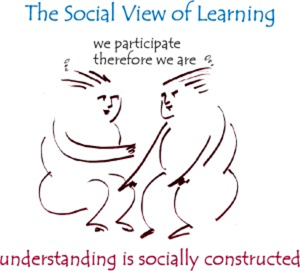
“We participate; therefore we are.” (Brown and Adler, 2008)
What exactly constitutes education or learning? As an educator with a computer science background, I contend that learning is different than knowledge or facts in the same way that data differs from information. Without a context, a fact is just a piece of data. It is only information or learning when it can be applied to something. Biggs and Tang (2007, p.21) are saying something similar, when they say, “The acquisition of information in itself does not bring about [effective learning changes], but the way we structure that information and think with it does.” They go on to say “education is about conceptual change, not just the acquisition of information.”
How do we elicit this conceptual change? How do we elicit this conceptual change? Biggs and Tang enumerate four precursors. The most interesting is the fourth: “[S]tudents work collaboratively and in dialogue with others, both peers and teachers.” (2008) call this “social learning” and explain that “our understanding of content is socially constructed through conversations about that content and through grounded interactions.” This fits in nicely with David Weinberger’s ideas about social knowing:
What you learn isn’t prefiltered and approved, sitting on a shelf, waiting to be consumed... Now we can see for ourselves that knowledge isn’t in our heads: It is between us. It emerges from public and social thought and it stays there, because social knowing, like the global conversations that give rise to it, is never finished.
Weinberger, 2007 p.146-147
Lifelong learning, like Weinberger’s social knowing, is never finished. It continues on outside the four walls of the classroom. It is on Twitter. It is on Facebook. It is in the student’s workplace. It is in the student’s home. It arises in conversations with the student’s friends and it arises in play. The social component, previously undervalued, is key.
Brown describes some research by Richard J. Light where Light discovered that the ability of students to form study groups was one of the strongest determinants of students’ success; it was more important than the instructors’ teaching styles (Light (2001) cited in Brown and Adler, 2008). Brown says this shifts our attention from the subject content to the learning activities and human interactions around them, which, while agreeing with Biggs, goes further by suggesting the instructor themselves is of lesser importance. Susan and Robert, becoming social, taking turns being teachers and learners together, is a powerful combination for deep learning.
World of Warcraft
The gamer’s mindset—the fact that they are learning in a totally new way—means they’ll treat the world as a place for creation, not just for consumption. This is the true impact videogames will have on our culture.” (Wright, 2006)
World of Warcraft (WoW), a massively multiple online role playing game (MMORPG) in the dungeons and dragons genre, is the most successful personal computer game ever released. As of 2008, it had more than 10 million active subscribers worldwide, amounting to 62.2% of the online gaming market (Yee, 2005).
Although it is a game, WoW, its communities, and its cultural artefacts share a number of commonalities with lifelong learning in online higher education. The first is that both have Roberts and Susans. The second is that both have structures that support ad-hoc groups where alliances shift, merge, and collapse dynamically as people come and go. The third is that both encourage the formation of communities of practice through their design and purposes (Wenger, 1999). Finally, they both, with varying degrees of success, encourage learning and collaboration that results in an ongoing learning journey continuing past the current goal.
Hagel and Brown (2009) enumerate eight “lessons” that businesses hoping to get their employees to collaborate, create, and innovate should draw from World of Warcraft:
- Reduce barriers to entry and to advance in initial stages
- Provide rich performance metrics
- Keep raising the bar
- Remember to account for and use intrinsic motivations
- Provide opportunities to develop shared knowledge not easily shared but don’t forget broader knowledge exchange
- Create opportunities for teams to self-organize around challenging goals
- Encourage frequent performance feedback
- Create an environment that rewards new dispositions
These lessons are just as applicable in fostering collaborative learning in online education and lifelong learning as in business, perhaps even more so. My mission is to discover how it applies.
Major Activities Undertaken
Making connections, forging links, firing neurons.
It was a fairly busy period. I attended a number of seminars, workshops and conferences, either in person or virtually (see Table 1). Some presentations were previously recorded.
|
October 2008
November 2008
December 2008
January 2009
|
February 2009
March 2009
May 2009
June 2009
|
Table 1: Conference, Seminars, & Workshops
List of conferences, seminars, and workshops attended virtually or in-person.
Although I have been teaching computing science and technology in higher education for over 14 years, I do not have a background or formal training in education. I decided to alleviate that in September by registering for H812: The Postgraduate Certificate in Academic Practice at The Open University, a 60-point course in their online distance education masters program. Upon completion, I will have my Higher Education Academy accreditation for teaching in HE. Prior to that point, I had already agreed to teach H810: Accessibility Online Learning: Supporting Disabled Students, another course in the online distance education program. It was, in fact, applying for a teaching post for this course that led me to decide to rekindle my Ph.D. by changing to something I already do: educational technology.
Teaching a pilot course is always a lot of work, especially one where you have a background in half the content—technology—but not necessarily in the other half—educational pedagogy. I spent quite a lot of time in the fall working through the course on my own, just ahead of my students. I have also been dipping into the material for another brand new course: H800: Technology-Enhanced Learning: Practices and Debates, a new course that just started this year, co-authored by Gráinne Conole. What all these courses have in common is exposure to different ideas in educational technology and pedagogy. From the accessibility and e-learning course, I picked up ideas about Wenger’s communities of practice, which I have incorporated into my thinking. From H800, I have been exploring ideas about digital natives and “the Google Generation”. From H809: Practice-Based Research in Educational Technology, I’ve acquired some guided readings on ethnography as a research method, which I suspect is one of the types of study I need to use for studying behaviour within World of Warcraft.
It is the course I am actually taking that has proven the most useful, though, as it has a guided introduction to many pedagogical theories, especially constructive alignment from Biggs & Tang (Brown & Adler, 2008). That material was directly usable in the book chapter proposal I submitted earlier this year, the bulk of which is now incorporated into this document.
For the second assignment, I did some analysis on a course I chair, examining how outcomes-based learning and teaching, a kind of constructive alignment, has not been properly employed in the course design and how that has resulted in students failing to persist and pass the course. That piece of research served as the basis for my recent “Making Connections” conference presentation. That assignment also included ideas about Robert and Susan and the increase in the number of Roberts, as well as the current nature and purpose of universities. Building on that analysis and inspired by Constance Steinkuehler’s work on scientific literacy practices in World of Warcraft communities, I developed an activity intended to improve academic literacy practices in my Open Source third-year students, and then evaluated the effect on demonstrated practices in their course practices; I presented some of those findings during my “Making Connections” talk, The Nutcracker Effect.
That Open Source course I chaired this year has fed into my thinking in other ways too as a direct result of my ongoing fascination with the ideas of John Seely Brown. In a keynote speech I watched, he was comparing evaluating the influence of “tinkering” on Open Source and how that ties into learning. One of my students innocently made a comment about how Open Source is very similar to learning too. It got me thinking about how tinkering is directly applicable to problem-based learning as well as deep learning, both topics related to activities I see taking place in World of Warcraft and ones I want to encourage in communities of practice for learning.
I do not spend time looking for relevant course materials. In actuality, useful material from other courses came to my attention because of people in my online personal learning networks with whom I interact via Twitter and Plurk primarily. That includes people like Gráinne Conole (OU), Martin Weller (OU), George Siemens (Manitoba), Bryan Alexander (NITLE), Howard Rheingold (Stanford), Steve Wheeler (Plymouth), Tony Hirst (OU), and Alan Cann (Leicester). I am also connected and in regular contact with a number of other Ph.D. students and researchers around the world, both in e-learning and games research.
Not all of the seminars and workshops I attended were immediately obviously applicable, although people I have met at them have fed into my work, like K. Faith’s Lawrence’s and her Ph.D. work on fan fiction and artifact production in LiveJournal communities (2008); or practices that encourage motivation and persistence from an Open University staff workshop. Ben du Boulay’s motivation reading group was also very helpful by picking out important theory papers from psychology and cognitive science in motivation, a topic I did not initially realize was of interest until I started regularly attending those meetings. Now motivation is a key element of what I want to investigate.
| Activity | Result |
|---|---|
H812: Postgraduate Certificate in Academic Practice |
2 essays; material for book chapter proposal; a conference presentation; constructive alignment; Roberts and Susans |
H810: Accessbility in Online Learning |
blog postings; introduction to communities of practice; inclusion & nature of universities |
H800: Technology-Enhanced Learning & Practices and H809: Practice-Based Research in Educational Technology |
Digital natives; Google generation; tinkering & J.S. Brown; ethnography as a research method |
Book chapter proposal |
Rejected but served as the basis for this document and thesis proposal; thesis topic. |
Seminars, workshops, conferences |
Ideas and people |
Twitter and Plurk |
Ideas, people, resources, discussion, and community. |
Table 2: Major Activities Summary
Activities and their outcomes
Progression and the Future
There’s much left to explore.
My immediate plan is to complete a literature review and formal thesis proposal by the end of October. That means a summer spent reading. I have some good starting points, both in e-learning, motivation, and game-related to learning areas, including Constance Steinkuehler’s World of Warcraft literacy research and Bonnie Nardi’s work. There is also more to read on John Seely Brown’s ideas on information spaces, learning, and tinkering. I feel I am in a good position to start and make good progress on that without getting too lost. I also can draw upon the advice and recommendations of others in my personal learning network, if need be.
I am anticipating at least three studies to complete my Ph.D. work. The first is a beta study to test out the research and data methodology for a larger-scale study in World of Warcraft. At this point, it is not clear whether the study will be an ethnographic study occurring in World of Warcraft directly or some other kind of research, like discourse analysis, on related artifacts like forums and web sites. That will be more evident after the thesis proposal has been written and I have a clearer idea of what specific questions I want the study to answer, perhaps after consultation with Dr. Ruth Woodfield from Sociology. However, I do know that I am looking for metaphors and systems for motivation and persistence that can be transported into an e-learning communities of practice environment. The second study would be the actual large-scale study intended to gather sufficient data to answer the posed questions.
The third study would take the hypothesis of motivation and persistence gained from the World of Warcraft studies and apply it to a subject online student population for positive improvements. I hope to facilitate something through my current connections at the Open University. This would be a good route as the student population in my undergraduate courses are quite large and could be divided into control and experimental groups. If an OU group is not possible, using a smaller group from Dr. Good’s online e-learning cohort might work. I am in the process of sounding out various people already at the Open University as to how I would go about obtaining permission to do that.
I am also actively looking for small JISC grant projects in related areas that I can apply for on my own. Dr. Tony Hirst (OU) has apparently figured out a way by which universities can be bypassed when applying for JISC funds, thus avoiding the universities annexing up to half for fixed costs out of an already small amount. He has already done this with one of his own projects (Winn, 2009), but I will admit he is in a better position than I am to pull it off. Still, it does not hurt to look and to try.
In addition to obtaining funding, another benefit of research grants is that they expect output, usually in the form of published papers or other documents. That would tie nicely into my plans to do a thesis comprised of a collection of papers (published or unpublished) as already permitted in Psychology at Sussex. With my attention deficit disorder, I feel this approach will be a lot easier for me to manage, as individual papers are self-contained and smaller units. My plan is to publish several papers. The initial research questions I have already could form at least one and the two major studies another two. The argument would be that published papers have already undergone some sort of peer review and, by publication, obtained far wider public exposure than most Ph.D. theses ever get. Dr. Good and Dr. Whitby are responsible for making this possible (or attempting to do so) on the departmental side. I would like to see the option available to everyone, but I am confident I should be able to get it as a reasonable accommodation for my disability.
My intention is to complete by spring of 2011. I will include a tentative timeline of things to be done and when in my thesis proposal at the end of October. In order to complete in 2011, I will need to make a change to my registration status as I am officially out of time in January 2010. I spoke to the postgraduate advisor at the beginning of the year. She believed the department would work with me to either restart my registration period or extend my current one. I am in the process of trying to get that sorted prior to the decommissioning of the school later this summer.
References
Biggs, J. & Tang, C. (2007) Teaching for Quality Learning at University, 3rd edition, Maidenhead, UK, Open University Press.
Blandeburgo, B. (2009)> ‘Activision “WoWs,” But Where’s Wireless?’, The Game Trade Journal, blog entry posted March 4, 2009. Available from: http://www.gametradejournal.com/2009/03/activision-wows-but-wheres-wireless.html (Accessed March 9, 2009).
Brown, J.S. & Adler, R.P. (2008) ‘Minds on Fire: Open Education, the Long Tail, and Learning 2.0’ Educause Review, 43 (1), [online] Available from: http://connect.educause.edu/Library/EDUCAUSE+Review/MindsonFireOpenEducationt/45823 (Accessed August 22, 2008).
Churches, A. (2008) Bloom’s Digital Taxonomy, [online] PDF. Available from: http://edorigami.wikispaces.com/Bloom’s%20Digital%20Taxonomy (Accessed January 20, 2009).
Clydesdale, T. (2009) ‘Wake Up and Smell the New Epistemology’, Chronicle of Higher Education, January 23, 2009, [online]. Available from: http://chronicle.com/free/v55/i20/20b00701.htm (Accessed January 23, 2009).
Fish, S. (2009) ‘Think Again’, The New York Times, blog entry posted January 18, 2009. Available from: http://fish.blogs.nytimes.com/2009/01/18/the-last-professor/ (Accessed January 22, 2009).
Hagel, J. & Seely, J.S. (2009) ‘How World of Warcraft Promotes Innovation’ Business Week Online, January 14 [online] Available from: http://www.businessweek.com/innovate/content/jan2009/id20090114_362962.htm (Accessed January 19, 2009).
Krathwohl, D.R. (2002) ‘A Revision of Bloom’s Taxonomy: An Overview’ Theory into Practice, 41 (4), [online] Available from: http://www.informaworld.com/smpp/content~db=all?content=10.1207/s15430421tip4104_2 (Accessed January 12, 2009).
Lawrence, K.F. (2008) The Web of Community Trust - Amateur Fiction Online: A Case Study in Community Focused Design for the Semantic Web. Ph.D. thesis, University of Southampton.
Weinberger, D. (2007) Everything Is Miscellaneous: The Power of the New Digital Disorder, New York, USA, Holt Paperbacks.
Santayana, G. (2005) The Life of Reason: The Phases of Human Progress, Project Gutenberg, [online] Available from: http://www.gutenberg.org/files/15000/15000-h/15000-h.htm
Wenger, E. (1999) Communities of Practice: Learning, Meaning, and Identity, Cambridge, UK, Cambridge University Press.
Wesch, M. (2008) ‘A Vision of Students Today (& What Teachers Must Do)’, Britannica.com, blog entry posted October 21, 2008. Available from: http://www.britannica.com/blogs/2008/10/a-vision-of-students-today-what-teachers-must-do/ (Accessed October 21, 2008).
Winn, J. (2009) ‘JISCPress: Developing a Community Platform for the JISC Funding Process’, The Learning Lab, blog entry posted June 5, 2009. Available from: http://joss.blogs.lincoln.ac.uk/2009/06/05/jiscpress-developing-a-community-platform-for-the-jisc-funding-process/ (Accessed June 5, 2009).
Wright, W. (2006) ‘Dream Machines’, Wired, 14.04
Woodcock, B.S. (2008a) MMOGCHART.Com, [online]. Available from: http://www.mmogchart.com/ (Accessed March 8, 2009).
Woodcock, B.S. (2008b) An Analysis of MMOG Subscription Growth: Version 23.0, [online]. Available from: http://www.mmogchart.com/analysis-and-conclusions/ (Accessed March 8, 2009).
Yee, N. (2004) Player Demographics, [online] The Daedalus Project. Available from: http://www.nickyee.com/daedalus/gateway_demographics.html (Accessed March 9, 2009).
Yee, N. (2005) ‘WoW Basic Demographics’, The Daedalus Project, blog entry posted July 28, 2005. Available from: http://www.nickyee.com/daedalus/archives/001365.php (Accessed March 9, 2009).
Contact Details
Michelle A. Hoyle -- June 7, 2009
http://einiverse.eingang.org/
eingang AT sussex DOT ac DOT uk
Downloadable Resources:
-A4 PDF Version of Levelling Lifelong Learning: Progress Report 2008/2009 (612 KB)
February 13, 2009
What Am I Doing? The Two-Sentence Summary
For the last several months, I've been engaged in various activities all with the same intended goal: generate a concrete idea about what specifically I want to look at in Michelle 2.0, my new Ph.D. I've been mind mapping, writing permutation programs, brainstorming, discussing, writing essays, and writing thesis proposal plans. The most successful thing was probably having to sum up what I'm doing briefly for a visitor to the research lab's weekly meeting this morning. While it answers the Twitter question "What are you doing?", it's too long to fit in 140 characters but it does fit into 40 words.
Q: What are you doing?
A: Looking at how metaphors and game design of World of Warcraft motivate people to learn and to work, with an eye to transferring motivation, social knowledge building, and persistence to online distance education practices, like teaching and community building.
There you go. Now we all know!
I'd just like to point out, though, that my ability to verbalize it so coherently and concisely is a result of all the other writing and thinking I've been doing. If I hadn't written the essay in November and the extremely rough paper outline for a thesis proposal on Sunday, the idea would not have coalesced so concretely. Time, background cogitation and serendipity seem to be strong features of my new Ph.D. For me, not knowing exactly what I wanted to do, has been sharply focussed by talking, reading, writing, and going to seminars. It doesn't matter what the seminars were or how relevant. It's amazing how much I've drawn out of the motivational reading group I was participating in when I didn't even know I was interested in motivation. Connections appear where you least expect them. The important thing is to take the leap and do.