• Open University Meet for Games Researchers

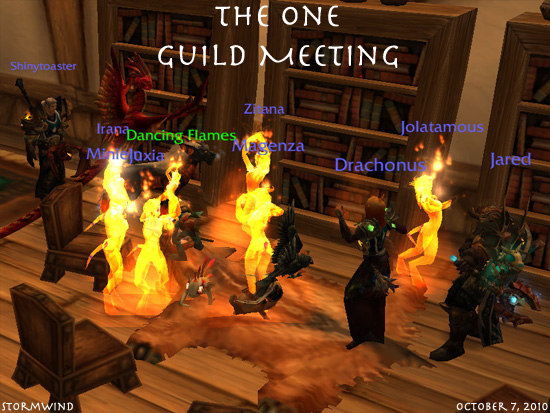
    Screenshot of a recent typical One guild meeting
    Credit: Michelle A. Hoyle Attribution-NonCommercial-ShareAlike 2.0 License

    Image: A recent guild meeting where Irana (left) was initiated into The One. As always, there was dancing, but things got a little “hot.”

    Colleagues from the Institute of Educational Technology (IET) and Maths, Computing and Technology at The Open University (OU) are inviting other OU staff interested in gaming research to a meeting next week in Milton Keynes. Here’s part of the blurb from the DigiLab post describing the event:

    On Thursday, 21st October, Jo Iacovides (IET) and Marian Petre (Computing) are hosting an informal discussion on gaming research, with the aim of getting people from the OU who are interested in the area to meet up. Whether it’s using games for learning, considering game design, using gaming as a medium for understanding strategy or interaction, or anything else game-related, it would be great to hear from you.

    As I’m interested in motivation, learning, and communities of practice formation within World of Warcraft, this is right up my alley. I know Jo Iacovides, one of the organizers, is also interested in some similar topics, as we’ve corresponded previously, but I’m eager to make some other connections.  I doubt it will get as “heated” as some of my guild meetings, but it should be interesting.

    PS: If anyone knows of cheap ways to get from Milton Keynes Central to The Open University, please let me know! I currently use the Raffles taxi service and it’s about £5.00 each way; the taxi fare is almost as much as my rail fare from London. Thanks.

     
  • Hermeneutics as Methodology

    I was reading through Chapter 4 of Silverman’s (2010) Doing Qualitative Research.  This chapter looks at the methodological approaches that different students take.  This is, of course, an important part of having a framework from which to hang your analysis.  There are so many choices.  He starts off with some descriptions of students describing their work as discourse analysis, narrative, analysis, and hermeneutics.  At first I thought this was related to something I’d looked up earlier in the month, heutagogy, but it’s just that they both start with “he”.  Wikipedia defines hermeneutics like this:

    Hermeneutics (English pronunciation: /hɜrməˈnjuːtɨks/) is the study of interpretation theory, and can be either the art of interpretation, or the theory and practice of interpretation. Traditional hermeneutics — which includes Biblical hermeneutics — refers to the study of the interpretation of written texts, especially texts in the areas of literature, religion and law. Contemporary, or modern, hermeneutics encompasses not only issues involving the written text, but everything in the interpretative process. This includes verbal and nonverbal forms of communication as well as prior aspects that affect communication, such as presuppositions, preunderstandings, the meaning and philosophy of language, and semiotics.[1] Philosophical hermeneutics refers primarily to Hans-Georg Gadamer’s theory of knowledge as developed in Truth and Method, and sometimes to Paul Ricoeur.[2] Hermeneutic consistency refers to analysis of texts for coherent explanation. A hermeneutic (singular) refers to one particular method or strand of interpretation.
    Wikipedia (2010)

    It’s apparently related to computational semiotics or used in computational semiotics.  That reminds me of James Paul Gee again because he talks about the semiotics of things in his What Video Games Have To Teach Us about Learning and Literacy (2007).  Is it another sign that I need to be looking at Gee’s book on discourse analysis (Gee 2011)?

    References

    Gee, J.P. (2007) What Video Games Have To Teach Us About Learning and Literacy, 2nd edition, New York, NY, United States, Palgrave Macmillan.

    Gee, J.P. (2011) An Introduction to Discourse Analysis Theory and Method, 3rd edition, Abingdon, United Kingdom, Routledge.

    Silverman, D. (2010) Doing Qualitative Research: A Practical Handbook, 3rd edition, London, United Kingdom, Sage Publications Ltd.

    Wikipedia. (2010) Hermeneutics, [online] web page, Wikipedia. Available from: http://en.wikipedia.org/wiki/Hermeneutics (Accessed September 21, 2010).

     
-->