

 Posted by
 0 comments
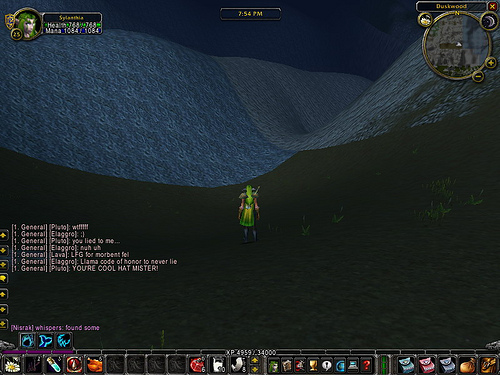
Credit: Screenshot by dyashman under an Attribution 2.0 Generic license
Image: The blurred boundary between the Stranglethorn Vale, Duskwood, and Deadwind Pass zones in World of Warcraft.
I posted this entry originally early in November, but somehow an entire paragraph disappeared, so I’ve re-posted it with a new date. — Michelle
_arien:
games based learning, i think has potential but learners struggle with transferring the learning & dealing with blurred boundaries #fote10Eingang:
@_arien I think you’re right that learners have trouble with learning when boundaries blurred like in GBL, because of context. #fote10_arien:
@Eingang exactly, our minds still work in boxes and takes practice to cross between formal and informal contextsEingang:
@_arien Blurred boundaries & different contexts are particularly problematic for, eg, people w autistic spectrum disorders. #h810 #fote10Eingang:
@_arien AR can help overcome the context issue/blurred boundaries of learning we were just discussing, because RL there too. #fote10
The above is an extract from a Twitter conversation I had on October 1st during the Future of Technology in Education conference (#fote10) with @_arien. Arien was attending the conference, watching Ollie Bray’s talk, while I was following the conference on Twitter. Arien, as it happens, is one of my Open University H810 students. Ollie Bray (@olliebray), of Learning & Teaching Scotland, was discussing the use of computer games in education.
I think Arien’s hit the nail on the head: it is about context. One of the reasons game skills don’t transfer to learning well is because learners/players do not see something in a game as being applicable to something academic. Much learning we do is completely context-based. Without the context of the “subject”, we do not necessarily think to apply something we have learned or maybe even realize that it is applicable.





 Posts Feed

